Building a Custom Home in 2027? What This Month's News Means for You, in Plain English
NMLS #769327 | CA Contractor License #1010953 | Licensed General Contractor
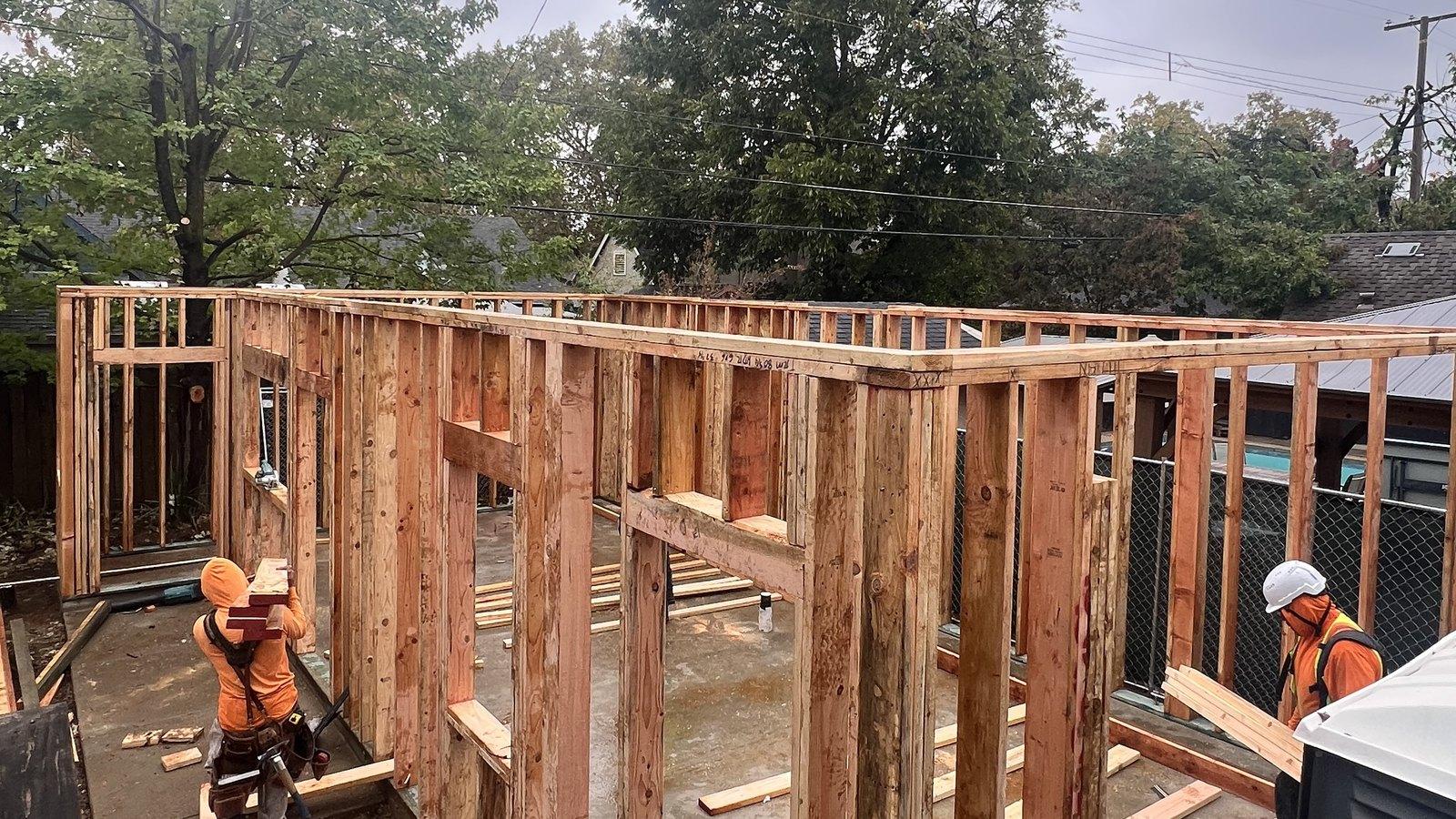
Framing day is my favorite day on any build. One morning there’s a flat concrete slab. By afternoon there are walls, window openings and doorways, and you can stand in what will be your kitchen and look out where your window will be. Families always get a little quiet the first time they walk through the framing. It’s when the dream starts to feel real.
I’m Aaron Meilich. I’ve spent 30 years in construction lending, and for the most recent 7 of them I’ve been building homes as well as lending on them. I’m also a Licensed General Contractor in California (CA #1010953). If you’re thinking about building your own home in 2027, a lot happened this month that’s worth understanding. Some of it is good news, some of it calls for a little planning, and none of it should scare you off. Here it is, in plain English.
The Quick Answer
- Builders want your business. Nearly half of builders cut prices this month, and more than two-thirds offered incentives.
- Custom homes are a real option. About 1 in 5 new single-family homes started in 2025 was a custom home.
- Mortgage rates ticked up after four weeks of declines.
- Congress is working on faster permits, though nothing is law yet.
- Choose your cabinets early. A tariff on imported cabinets is set to double on Jan. 1.
- Winter is planning season, and El Niño is shaping the weather.
1. Builders Are Looking for Work, and That Can Help You
Every month, the National Association of Home Builders (NAHB) asks builders how sales are going. In November, builder confidence fell to its lowest level since April 2012. 46% of builders cut prices, and 68% offered incentives to buyers, both the highest shares since Covid (NAHB Eye on Housing, Nov. 17, 2026).
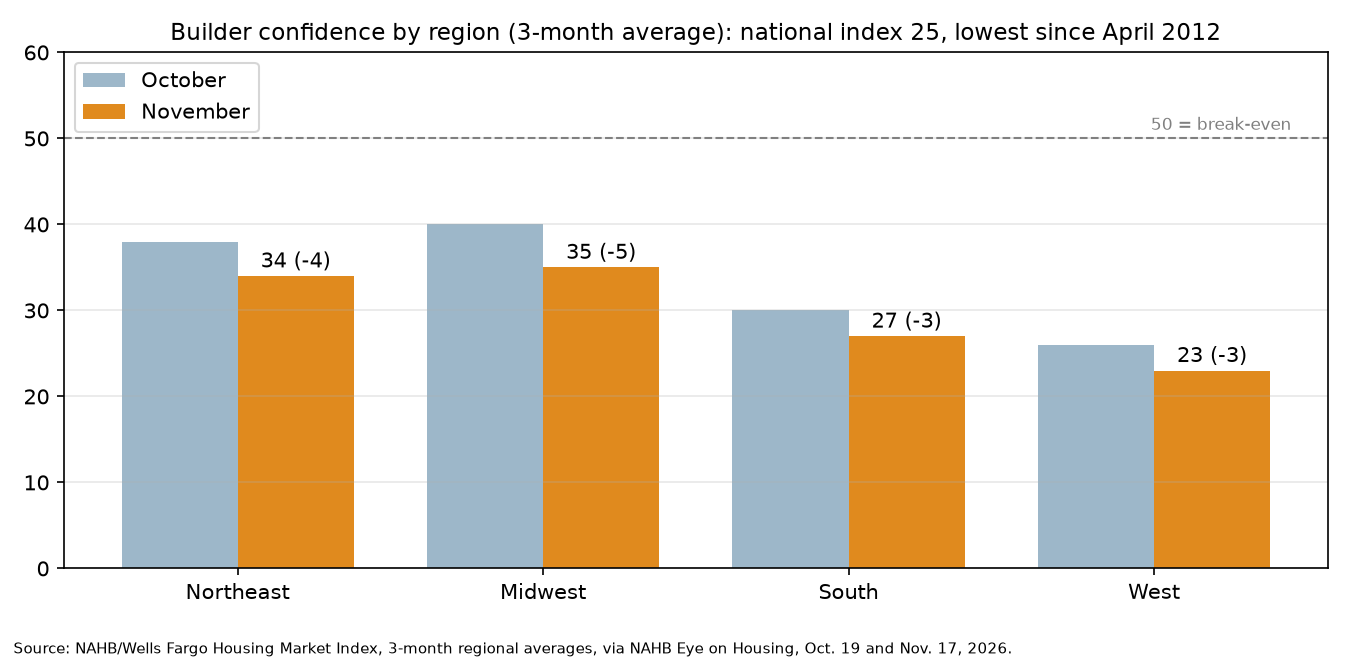
That’s tough news for builders, but it can be an opening for you. When builders are busy, it can be hard to get their attention. When things slow down, good builders have more time to sit down with you, walk your lot and give you a detailed bid.
One thing that hasn’t eased is the labor picture. In NAHB’s September survey, 47% of builders reported shortages in the nine trades the association has tracked since 1996, higher than during the mid-2000s building boom. Shortages were most common for finished carpentry (58%) and framing crews (57%), and the median increase in labor cost for the same home over the prior 12 months was 4.2% (NAHB Eye on Housing, Oct. 14, 2026).
What it means for you: interview two or three licensed, insured builders, ask for references, and compare bids line by line. Ask how long each price is good for, and how they plan to staff framing and finish work.
2. A Custom Home Is More Common Than You Might Think
A custom home is a house built one at a time, for you, on land you own, instead of a home a builder puts up first and then sells. In 2025, custom homes were 19.6% of all new single-family homes started, up from 17.5% in 2024. In New England, the share was 47% (NAHB Eye on Housing, Nov. 17, 2026). Custom starts have slowed this year, to 46,000 in the third quarter, down more than 11% from a year earlier (NAHB Eye on Housing, Nov. 19, 2026).
New homes can also compare well on price. In the third quarter, the national median price of a new home was $393,300, versus $432,900 for an existing home, a gap of nearly $40,000 (NAHB Eye on Housing, Nov. 19, 2026). A custom home is its own animal, of course: your price depends on your land, your plans and your finishes.
3. Mortgage Rates Ticked Back Up
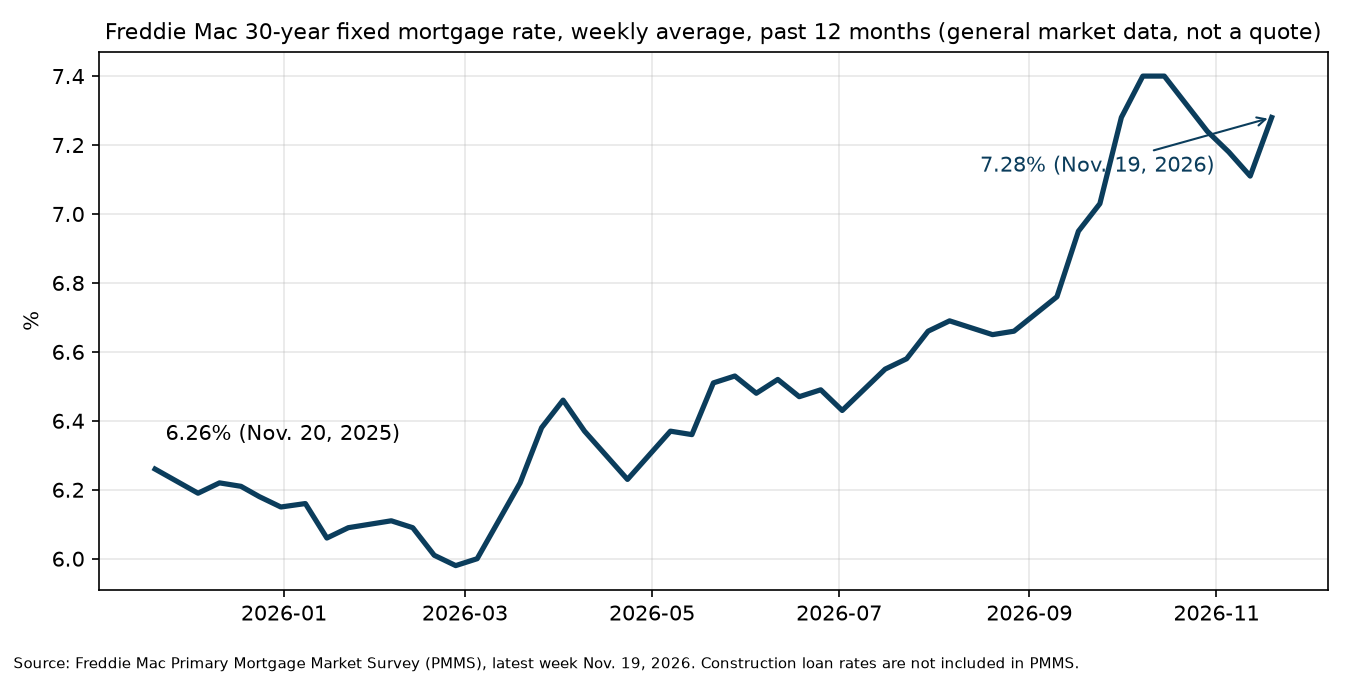
As of Nov. 19, 2026, Freddie Mac’s average 30-year fixed mortgage rate was 7.28%, up from 7.11% a week earlier, after four straight weekly declines. A year ago it was 6.26% (Freddie Mac PMMS, Nov. 19, 2026). Because of Thanksgiving, the next weekly survey is scheduled for Wednesday, Nov. 25.
A construction loan isn’t the same as a regular mortgage, and Freddie Mac’s survey doesn’t track construction loans. In my experience, construction loan rates typically run about 0.75% above conventional mortgage rates. Rates for construction loans are hovering in the high 7’s as a general market average. Your own rate depends on your program, your credit and your project.
What’s an APR? The annual percentage rate (APR) includes your interest rate plus certain loan costs, so it gives you a fuller picture of what borrowing costs. Rates shown are national market averages for general information only. They are not an offer, quote or rate lock, and the roughly 0.75% difference is a general rule of thumb, not a pricing promise. Your actual rate and APR depend on credit, loan program, property, loan amount and market conditions. Subject to credit approval; not a commitment to lend. Equal Housing Lender.
4. Congress Is Working on Faster Permits
A permit is the official approval you need before, and during, construction. On Nov. 19, the U.S. Senate passed a bill called the Bipartisan American Affordability and Jobs Act by a vote of 62 to 33. It now goes to the House, where its future is uncertain (CBS News, Nov. 19, 2026). For home building, the bill would make some federal water and wetlands permits quicker to get and let them last 10 years instead of five. NAHB estimates the faster permits can save up to a year and $425,000 on a land development project (NAHB, Nov. 20, 2026).
Closer to home, states and cities are trying too. Massachusetts’ governor wants lawmakers to allow single-family homes on smaller lots (NBC Boston, Nov. 17, 2026), and Washington State eased energy-code rules for families rebuilding after the Spokane Complex Fire (City of Spokane, Nov. 20, 2026).
What it means for you: most of the rules that affect your build are still local. Before you buy land, ask the city or county what you can build there, how long permits are taking and what the fees are.
5. Pick Your Cabinets (and Your Must-Haves) Early
The tariff on imported kitchen cabinets and vanities is set to rise from 25% to 50% on Jan. 1, 2027, for countries without a trade deal, including Canada (Reuters, Nov. 5, 2026; Wood Central, Nov. 23, 2026). Framing lumber, meanwhile, slipped for a seventh straight week, to $440 per 1,000 board feet (Madison’s Lumber Reporter, Nov. 20, 2026). Even with lumber easing, overall costs are still climbing: NAHB reports that the price of inputs to new residential construction was 10.4% higher in October than a year earlier, and goods used in new homes were up 9.8% (NAHB Eye on Housing, Nov. 13, 2026).
Your selections are the choices you make for finishes: cabinets, counters, flooring, fixtures. Making them early helps your builder price the home accurately and order on time. Ask where your cabinets are made and when they’ll ship. Those interior choices also take the most time and money. NAHB’s October survey found that interior finishes take 6.4 weeks on average, longer than any other stage, and account for more than 24% of a builder’s construction costs. A typical single-family home built for sale takes about 25.3 weeks (roughly 5.8 months) from start to finish; Census data show custom homes take significantly longer (NAHB Eye on Housing, Nov. 2, 2026).
While you’re at it, think about how your family will live in the home for years. Angi’s 2027 trends report highlights “homes that grow with you,” like a bedroom and accessible bath for a parent who may move in, and notes more homeowners are using AI to sketch ideas before handing them to a licensed pro to make them buildable (Forbes, Nov. 17, 2026). Building new is the easiest time to plan for those things.
6. Winter Is Planning Season (El Niño Edition)
NOAA’s December outlook calls for a strong El Niño pattern: a better chance of a wet month along the California coast and across much of the South and Southeast, milder temperatures across much of the northern U.S., and a chance of colder snaps in the East (NOAA Climate Prediction Center, Nov. 19, 2026). Builders work through winter all the time. For many families, though, these months are the perfect time to get ready for a spring start:
- Talk with a construction lender first so you know your budget before you shop for land or plans.
- Find your lot, or confirm what you can build on the land you have.
- Interview builders and compare detailed bids.
- Finalize plans and selections, especially cabinets.
- Ask about permits, fees and timelines in your city or county.
How a Construction Loan Works, in Plain English
Building a home is paid for differently than buying one. A construction loan pays your builder in draws, which are payments released as each stage of work (like the foundation or the framing you see in the photo above) is finished and checked.
The feature I recommend most often is a one-time-close construction-to-permanent loan. “One-time close” means you apply once and close once, before construction begins. The same loan pays for the build and then becomes your regular mortgage when your home is finished. You don’t have to qualify for a second loan or sit through a second closing at the end, and you know your financing plan before the first shovel hits the dirt. (Program availability and terms vary; subject to credit approval.)
Let’s Plan Your Build Together
Building your own home is one of the most exciting things you’ll ever do, and you don’t have to figure it out alone. I’ve stood on the jobsite on framing day and sat at the closing table, and I love helping families turn a dream and a set of plans into a real budget and a real schedule.
Get prequalified at ConstructionLoans.homes or call (916) 798-3000 to talk through your plans and construction financing options. No pressure, just a conversation about what’s possible.
— Aaron Meilich, Construction Lending Specialist, ConstructionLoans.homes
About the Author
Aaron Meilich is a licensed General Contractor and Construction Mortgage Specialist (NMLS #769327, CA Contractor License #1010953), based in Sacramento, California. He has about 30 years in construction financing and has also been building homes for the last 7 years. He originates VA, Conventional, and Jumbo one-time-close construction-to-permanent loans, and helps families and builders nationwide. Licensed in all U.S. states except Hawaii and New York. Call (916) 798-3000 or get prequalified.
Aaron Meilich, NMLS #769327 | CA Contractor License #1010953 | Equal Housing Lender. Subject to credit approval; not a commitment to lend. Licensing & disclosures: www.FundandBuild.com. For licensing information, visit www.nmlsconsumeraccess.org.
Frequently Asked Questions
Is 2027 a good time to build a custom home?
It depends on your plans and your budget. Right now many builders are cutting prices and offering incentives, lumber prices have eased, and mortgage rates are above 7%. Get current bids and talk with a construction lender to see what fits.
What is a custom home?
A home built one at a time for you, on land you own, with you or a builder acting as the general contractor. Custom homes were 19.6% of new single-family starts in 2025.
What is a one-time-close construction loan?
It's one loan with one application and one closing that pays for building your home and then becomes your regular mortgage when the home is finished.
How do construction loan rates compare with regular mortgage rates?
As of Nov. 19, 2026, Freddie Mac's average 30-year fixed rate was 7.28%. Construction loans typically run about 0.75% above conventional mortgage rates, depending on the program, borrower and project. These are market averages, not a quote; your rate and APR will vary.
What is a construction loan draw?
A draw is a payment from your construction loan to your builder after a stage of work, like the foundation or framing, is finished and checked.
Will tariffs make my new home cost more?
Some items may. The tariff on imported cabinets and vanities is scheduled to double to 50% on Jan. 1, 2027. NAHB also reports that the price of inputs to new residential construction was 10.4% higher than a year ago in October. Choosing selections early and asking where products come from can help you plan.
Featured Construction Loan Programs
Nationwide lending solutions customized to your build
Licensed in all U.S. states except Hawaii and New York.
Single closing with upfront rate lock and automated 30-year conversion.
VA, Conventional, and Jumbo one-time close construction loans.
Zero down payment, no monthly PMI custom home builds for veterans.
Ready to Structure Your Construction Loan?
Calculate your monthly construction interest, evaluate project equity, and get pre-qualified in under 3 minutes.