How Long Does It Take to Build a House? The 7 Stages, Explained in Plain English
NMLS #769327 | CA Contractor License #1010953 | Licensed General Contractor
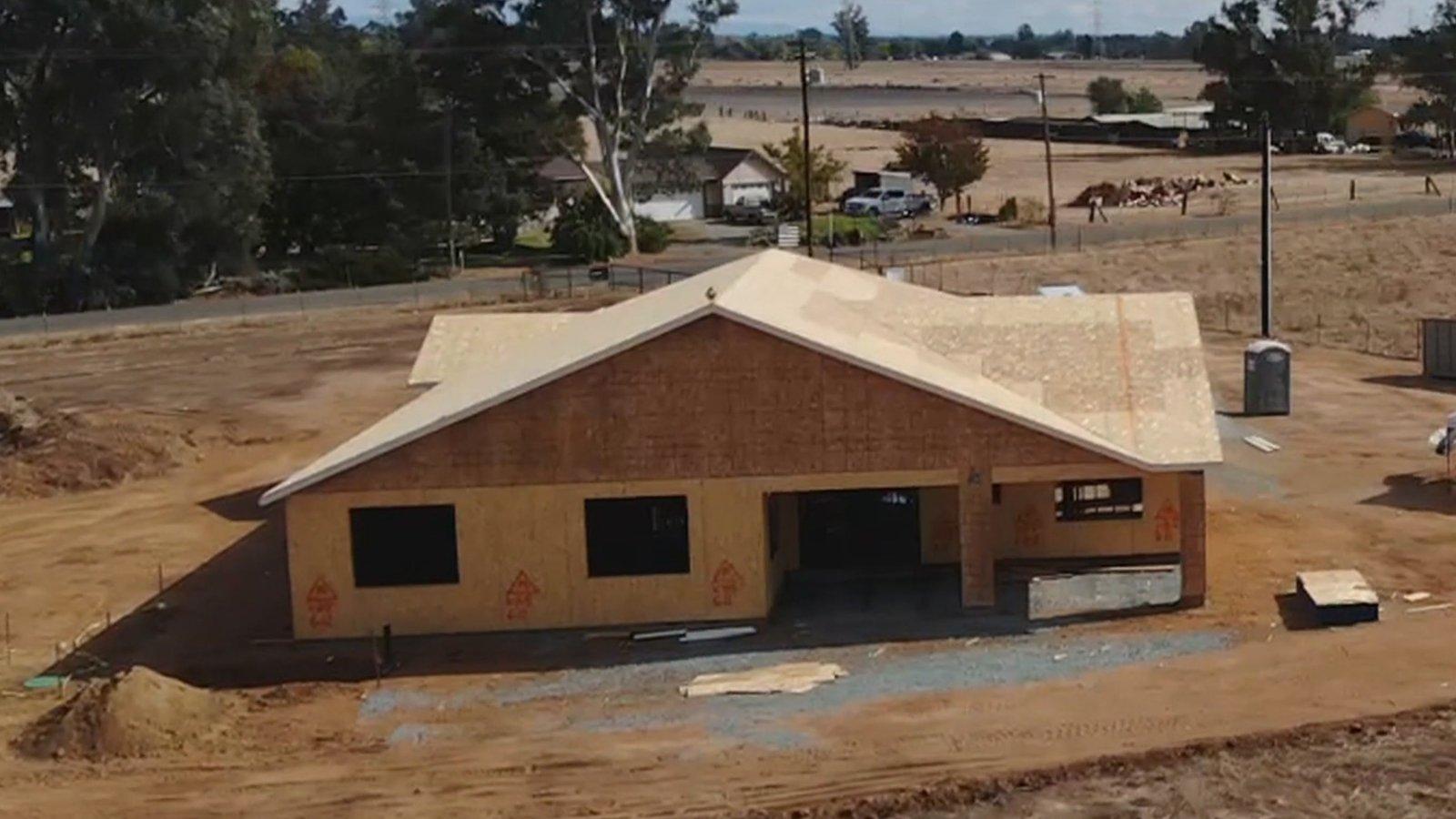
“How long will it take?” It’s almost always one of the first questions I hear from families who are thinking about building a home. It’s a great question, because the answer shapes everything else: when you give notice on your lease, when you sell your current home, and how you plan your budget.
I’m Aaron Meilich. I’ve spent 30 years in construction lending, and for the most recent 7 of them I’ve been both building homes and lending on them. I’m also a Licensed General Contractor in California (CA #1010953). So I’ve seen schedules from both sides of the table. Let me walk you through how long building really takes, stage by stage, in plain English.
The Quick Answer
Once construction actually starts, the average single-family home takes about 25.3 weeks, or roughly 5.8 months, to build, according to a survey of home builders released Nov. 2 by the National Association of Home Builders. That lines up with the U.S. Census Bureau’s average of 6.1 months from start to finish for homes built for sale in 2025 (NAHB Eye on Housing, Nov. 2, 2026).
Two important notes:
- Custom homes usually take longer. Census figures show that homes built one at a time on the owner’s lot take significantly more time than homes built for sale (NAHB, Nov. 2, 2026).
- The clock starts after the planning. Finding land, designing your home, getting a bid, getting a permit (the city’s official approval to build) and arranging financing all happen before the first shovel hits the dirt. Plan for that time too.
The 7 Stages of Building a Home
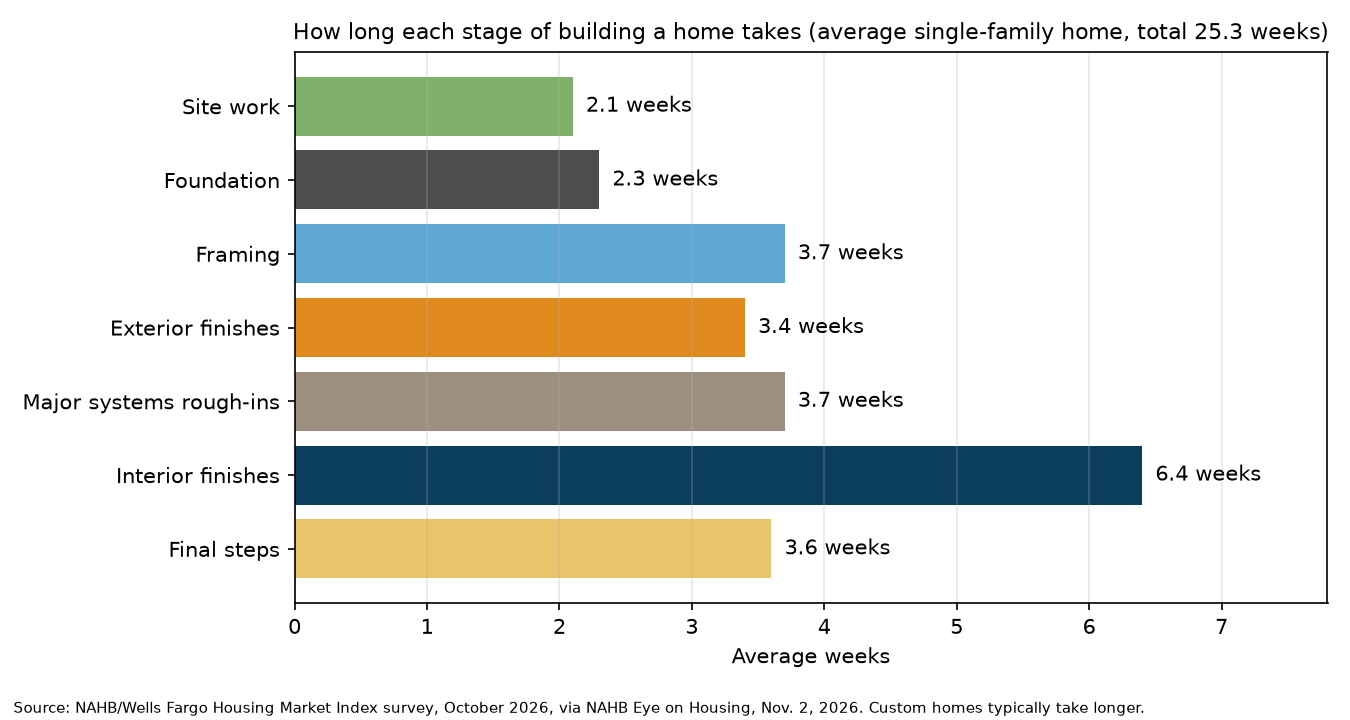
Here’s what happens at each stage, using NAHB’s average times (NAHB, Nov. 2, 2026):
- Site work (about 2.1 weeks). Clearing the lot, grading (shaping the ground so water drains away from the house) and bringing in utilities. Think of it as getting the land ready.
- Foundation (about 2.3 weeks). Pouring the concrete base your home sits on. That might be a slab (a flat concrete pad), a crawl space or a basement, depending on where you live.
- Framing (about 3.7 weeks). The exciting part! The wood skeleton of walls, floors and roof goes up, and suddenly you can walk through your future rooms.
- Exterior finishes (about 3.4 weeks). Roofing, windows, doors and siding. Once the roof and windows are in, builders say the house is “dried in,” meaning weather can’t get inside anymore.
- Major systems rough-ins (about 3.7 weeks). “Rough-in” means installing the parts of your plumbing, electrical and heating and air conditioning that will be hidden inside the walls, before the walls are closed up. An inspector checks this work.
- Interior finishes (about 6.4 weeks). The longest stage: drywall, interior doors, paint, cabinets, countertops, plumbing fixtures and flooring. It’s also the most expensive stage, accounting for over 24% of a builder’s construction costs.
- Final steps (about 3.6 weeks). Landscaping, driveways, decks and cleanup, plus a final walk-through and a “punch list” (a list of small fixes before you move in). The city then issues a certificate of occupancy, its official OK to live in the home.
The big lesson? The choices you make about finishes matter for your schedule. Picking your cabinets, tile and flooring early, and sticking with them, is one of the best ways to keep interior finishes, the longest stage, on track.
What Can Slow Things Down
Every build is different, and the time it takes depends on where you live, your design and your builder (NAHB, Nov. 2, 2026). Here are the most common reasons a schedule stretches:
- Weather. In cold climates, concrete has to be protected from freezing while it cures. One Utah builder plans for roughly 10% to 20% more framing time in winter because of snow, icy surfaces and short days (Ensign Custom Homes, Oct. 26, 2026).
- Changes mid-build. A “change order” is a written change to the plans after construction starts, like moving a wall or upgrading a countertop. Changes can add both time and cost.
- Permits and inspections. Every city has its own timeline. Some are speeding things up with technology; Denver just launched an AI tool that instantly checks permit applications for missing information before they’re submitted (City and County of Denver, Nov. 5, 2026).
- Materials. Back-ordered windows or a late cabinet delivery can hold up the next trade.
Can You Build Through the Winter?
Yes! Good builders build year-round. They adjust: a heated tent over the foundation when it’s very cold, temporary heat inside once the house is closed up, and a little fresh air to help drywall dry properly. Some outside jobs, like exterior painting or final grading, may simply wait for warmer days (Wayne Homes, Nov. 5, 2026). Ask your builder how they handle winter and whether extras like snow removal or temporary heat are included in your price.
What’s Happening With Building Costs
Here’s some encouraging news. Lumber, one of the biggest materials in a new home, has been getting cheaper. A widely followed price index fell for the fifth week in a row to $449 per 1,000 board feet in the week ending Nov. 6, down 10% from a month earlier (Madison’s Lumber Prices Index via Lesprom Network, Nov. 7, 2026). Some other products, like certain siding and decking brands, have price increases scheduled for late November and December (Mead Lumber Market Update, November 2026), so it’s smart to ask your builder for written pricing.
And if you live in California, keep an eye on Proposition 37, which voters approved last week. It allows a new state program of second loans of up to 17% of the price of a qualifying newly built home for eligible middle-income buyers. The state still has to set up the details (California Legislative Analyst’s Office, Prop. 37 analysis; Inman, Nov. 4, 2026).
Where Rates Stand Right Now
As of Nov. 5, 2026, Freddie Mac’s average 30-year fixed mortgage rate was 7.18%, down from 7.24% the week before and the third weekly drop in a row (Freddie Mac PMMS, Nov. 5, 2026). The next weekly survey comes out Nov. 12. Construction loans typically run about 0.75% above conventional mortgage rates, which would put them somewhere around 7.9% as a general market average, depending on the program, the borrower and the project.
Rates shown are national market averages for general information only. They are not an offer, quote or rate lock, and construction loan rates are not part of the Freddie Mac survey. Your actual rate and APR (annual percentage rate, which includes certain loan costs) depend on credit, loan program, property, loan amount and market conditions. Subject to credit approval; not a commitment to lend. Equal Housing Lender.
How a Construction Loan Follows Your Build
A construction loan pays for your home while it’s being built. Instead of paying your builder everything up front, the lender releases money in stages called draws, usually lined up with the stages above: one after the foundation, one after framing, and so on. Before each draw, an inspector checks that the work is really done.
With a construction-to-permanent loan (also called a one-time close), the construction loan and your long-term mortgage are one loan. You apply once, close once, and when the home is finished the loan becomes your regular mortgage.
The Part My Clients Appreciate Most
Every build has surprises: a buried rock in the excavation, a backordered window, an upgrade you decide you can’t live without. On many of the construction loan programs I work with, the project budget can include a contingency reserve, a cushion set aside inside the loan for unexpected costs, so a surprise doesn’t automatically mean a scramble for cash in the middle of your build. (Availability and amount vary by program; subject to credit approval and program guidelines.)
5 Questions to Ask Your Builder About the Schedule
- “How long do your homes like mine usually take, start to finish?” Ask for real examples, not just a best case.
- “When do I need to make my selections?” Finishes drive the longest stage, so know your deadlines.
- “How do you handle winter or rainy weather?” And what does it cost?
- “How do change orders work?” Ask how they’re priced, approved in writing and scheduled.
- “How will you keep me updated?” Weekly updates and photos make the whole process less stressful.
Frequently Asked Questions
How long does it take to build a house? Once construction starts, the average single-family home takes about 25.3 weeks, or roughly 5.8 months, according to an October 2026 NAHB builder survey. Custom homes usually take longer, and planning, design and permits happen before that.
What is the longest stage of building a home? Interior finishes, which include drywall, paint, cabinets, countertops, fixtures and flooring. They take about 6.4 weeks on average and account for over 24% of a builder’s construction costs.
Does building in winter take longer? It can. Builders protect concrete from freezing, use temporary heat and may move some outdoor work to spring. One Utah builder plans for roughly 10% to 20% more framing time in winter.
What is a construction loan draw? A draw is a payment from your construction loan to your builder after a stage of work, like the foundation or framing, is finished and inspected.
What is a construction-to-permanent loan? It’s one loan that pays for building your home and then becomes your regular mortgage when the home is finished, with one application and one closing.
How do construction loan rates compare with regular mortgage rates? As of Nov. 5, 2026, Freddie Mac’s average 30-year fixed rate was 7.18%. Construction loans typically run about 0.75% above conventional mortgage rates, depending on the program, borrower and project. These are market averages, not a quote; your rate and APR will vary.
Let’s Map Out Your Timeline Together
Building a home is one of the most exciting things a family can do, and knowing what to expect makes it a lot more fun. I’ve swung the hammer and sat at the closing table, and I’d love to help you turn your plans into a realistic schedule and a financing plan that fits.
Get prequalified at ConstructionLoans.homes or call (916) 798-3000 to talk through your plans and construction financing options. No pressure, just a conversation about what’s possible.
— Aaron Meilich, Construction Lending Specialist, ConstructionLoans.homes
About the Author
Aaron Meilich is a licensed General Contractor and Construction Mortgage Specialist (NMLS #769327, CA Contractor License #1010953), based in Sacramento, California. He has about 30 years in construction financing and has also been building homes for the last 7 years. He originates VA, Conventional, and Jumbo one-time-close construction-to-permanent loans, and helps families and builders nationwide. Licensed in all U.S. states except Hawaii and New York. Call (916) 798-3000 or get prequalified.
Aaron Meilich, NMLS #769327 | CA Contractor License #1010953 | Equal Housing Lender. Subject to credit approval; not a commitment to lend. Licensing & disclosures: www.FundandBuild.com. For licensing information, visit www.nmlsconsumeraccess.org.
Featured Construction Loan Programs
Nationwide lending solutions customized to your build
Licensed in all U.S. states except Hawaii and New York.
Single closing with upfront rate lock and automated 30-year conversion.
VA, Conventional, and Jumbo one-time close construction loans.
Zero down payment, no monthly PMI custom home builds for veterans.
Ready to Structure Your Construction Loan?
Calculate your monthly construction interest, evaluate project equity, and get pre-qualified in under 3 minutes.