Midwest Builders: Milwaukee Opens Its Zoning Rewrite, Ohio Lines Up Pre-Approved Plans, and Lumber Keeps Sliding (Week of Nov. 16, 2026)
NMLS #769327 | CA Contractor License #1010953 | Licensed General Contractor
Short answer: Milwaukee is publishing proposed zoning changes on Nov. 16, with public sessions Nov. 17, 19 and 20. Columbus, Cleveland and Cincinnati are the first targets of a statewide effort to create pre-approved, construction-ready plans for duplexes through sixplexes, including modular and panelized versions. A Northern Michigan township approved its first new neighborhood in decades. Framing lumber fell for a sixth straight week, though overall construction input costs are still up 10.4% from a year ago, and Midwest builder sentiment remains the strongest of the four regions.
After 30 years in construction lending and the last 7 building homes too, I pay close attention to anything that makes a permit more predictable. Predictable permits mean predictable draw schedules, and that’s what keeps a project on budget. Here’s what Midwest builders should know this week.
Zoning: Milwaukee Starts Turning Its Housing Plan Into Code
Milwaukee’s Department of City Development is posting proposed zoning code changes at engage.milwaukee.gov/housing-tune-up on Monday, Nov. 16. The update covers small-scale infill housing, larger multi-unit and mixed-use buildings, design standards and technical fixes, and the city says it won’t change the zoning already assigned to individual properties. Dinner-and-learn sessions are Nov. 17 (UMOS, 2701 S. Chase Ave.) and Nov. 19 (Washington Park Senior Center), with drop-in office hours Nov. 20 at the Zeidler Municipal Building (Hoodline, Nov. 13, 2026).
Context matters here: the Common Council legalized ADUs in single-family zones in July 2025 by an 8-7 vote, and the adopted Housing Element still recommends townhouses, cottage courts and ADUs in single-family districts, which cover about 40% of the city (Hoodline, Nov. 13). If you build infill in Milwaukee, this is the week to read the draft and show up.
Permitting: Ohio’s Pre-Approved Plans Take Shape
Smart Growth America, the Housing Multiplier Project and the Greater Ohio Policy Center are commissioning construction-ready plans for two-family, triplex, fourplex and sixplex buildings, in both traditional wood-frame and modular or panelized versions. Columbus, Cleveland and Cincinnati come first. The design RFP caps the budget at $275,000, construction documents go to the three cities for review by Feb. 15, and each city keeps final say on whether the designs are treated as pre-approved. Cincinnati’s separate BuildReady project, funded by a $2 million federal grant, plans two demonstration projects in 2027 (Government Market News, Oct. 16, 2026).
The idea is simple: the city reviews a design once, and builders who use it face fewer unknowns. Site-specific approvals and zoning still apply, so it isn’t a blank check, but it can take weeks of plan-review risk out of a small infill project. A new federal GAO technology assessment lists “implement and scale preapproved housing design libraries” among its 14 policy options for boosting supply (U.S. GAO, GAO-27-108037, Nov. 10, 2026).
New Neighborhoods and New Rules
- Manistee Township, Mich. approved an 86-home neighborhood (72 single-family homes and 14 duplexes) on about 27.8 vacant acres, the area’s first new neighborhood in decades. Duplexes come first, with groundbreaking expected in spring 2027, and the roughly $23.5 million project uses a non-environmental tax increment plan approved with the Brownfield Redevelopment Authority and MSHDA (MLive, Nov. 5, 2026).
- Kansas SB 418, which allows homes on smaller lots, is one of 10 state laws passed this year that the American Enterprise Institute estimates could together add about 103,000 homes a year nationally (Realtor.com, Nov. 6, 2026).
Market Check
Midwest builders remain the most upbeat in the country, relatively speaking. On NAHB’s three-month average, the Midwest Housing Market Index was 40 in October, versus 38 in the Northeast, 30 in the South and 26 in the West, and NAHB pointed to Midwest single-family permits up 2.9% (HousingWire, Oct. 19, 2026). On the other hand, a UNLV study of Census permit data for the first eight months of 2026 described permitting in the more affordable Midwest as stagnant (Realtor.com, Nov. 9, 2026). Midwest existing home sales fell 3.2% in October to a decade low (NAHB Eye on Housing, Nov. 12, 2026).
Builder credit is still tight. NAHB’s survey of builders and developers shows conditions on land, development and construction loans tightened for the 19th straight quarter in Q3 2026. The same survey found that 32% of builders who built single-family homes in Q3 financed some of them with a construction-to-permanent (one-time close) loan made to the home buyer, and on average 58% of those builders’ homes were financed that way (NAHB Eye on Housing, Nov. 13, 2026).
Design Note: Comfort Features Buyers Can Feel
Zillow’s 2027 Home Trends Report, based on millions of for-sale listings, shows mentions of whole-home batteries up 43%, fresh-air ventilation systems (energy- and heat-recovery ventilators) up 52%, radon mitigation up 18% and home offices up 42%, while “sustainable” and “green” buzzwords fell 26% (Zillow 2027 Home Trends Report, Nov. 10, 2026). For Midwest buyers dealing with cold winters, tight houses and radon, those are features worth pricing into the plans.
Lumber and Material Prices This Week
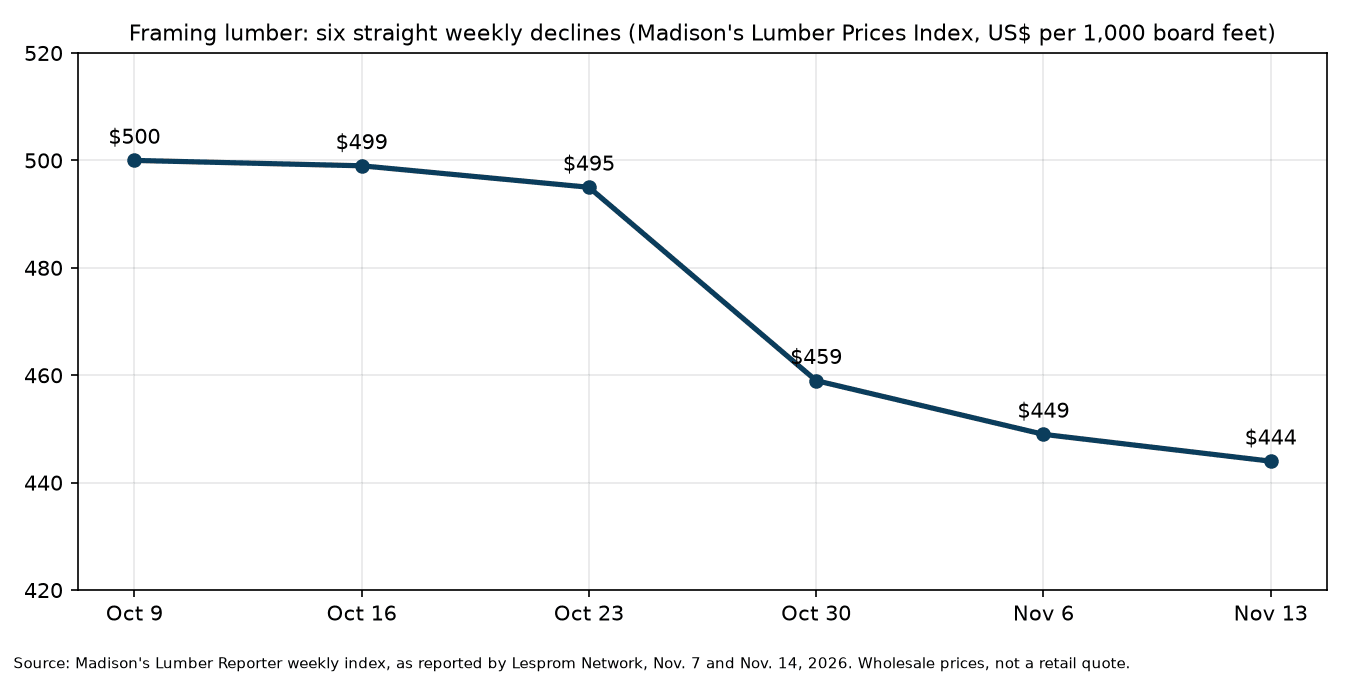
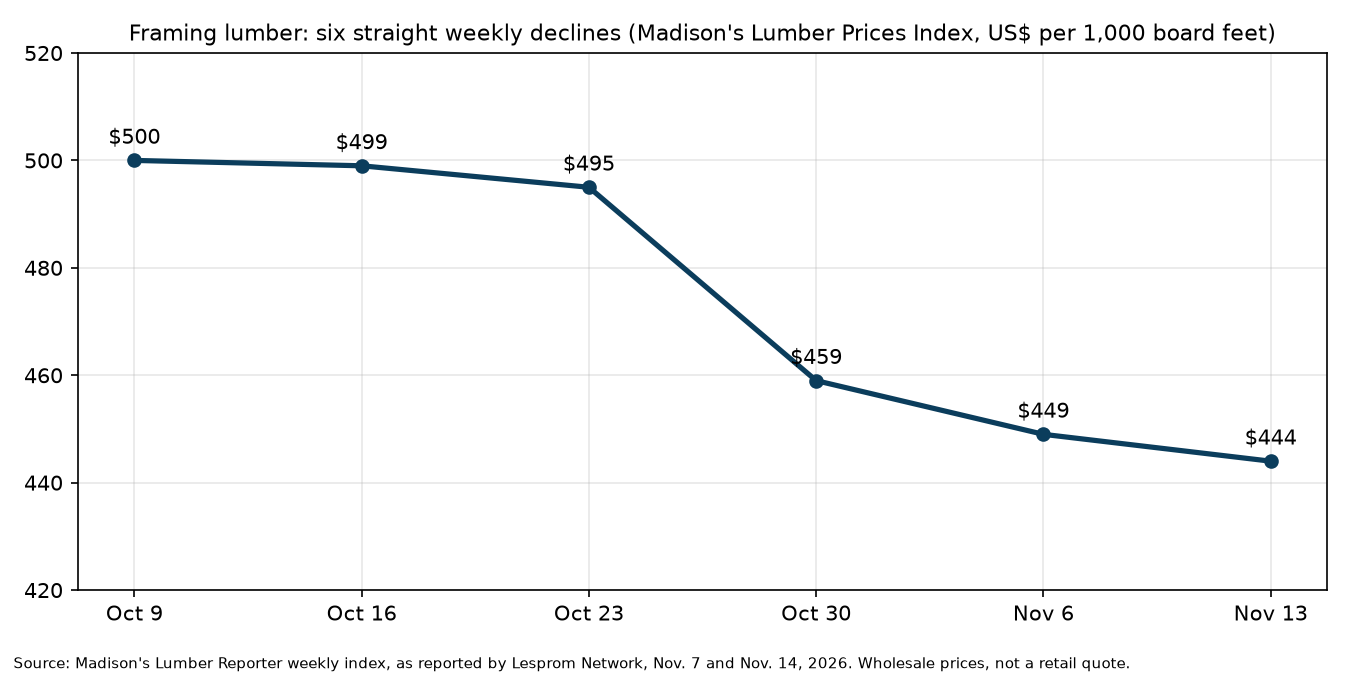
Madison’s Lumber Prices Index slipped to $444 per 1,000 board feet for the week ending Nov. 13, down $5 (1%) on the week and $51 (10%) from a month earlier. It was the sixth straight weekly decline (Lesprom Network, Nov. 14, 2026; Madison’s Lumber Reporter, Nov. 13, 2026).
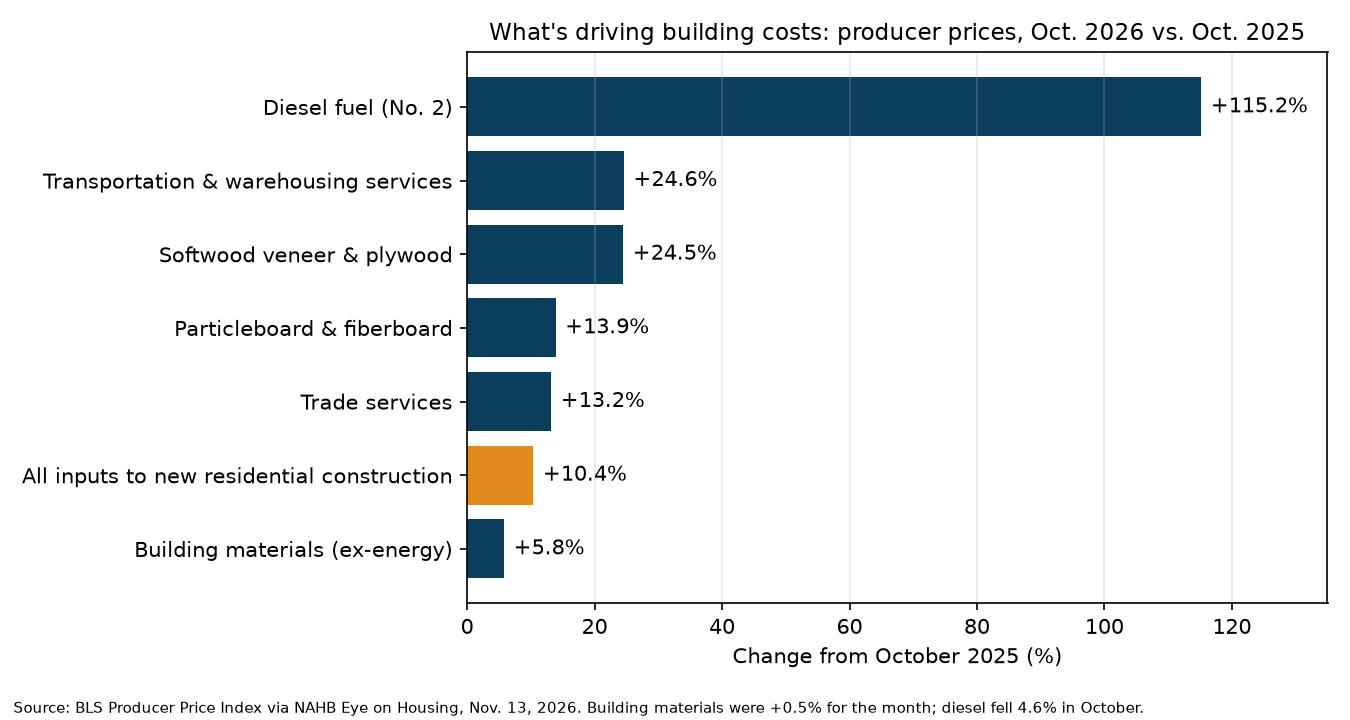
The broader cost picture is less friendly. Prices for all inputs to new residential construction were up 0.3% in October and 10.4% from a year earlier. Building materials alone rose 0.5% on the month and 5.8% on the year, softwood plywood is up 24.5%, and diesel fuel, even after a 4.6% monthly drop, is up 115.2% from a year ago (NAHB Eye on Housing, Nov. 13, 2026).
Seasonal Best Practices for Midwest Jobsites
NOAA’s winter outlook favors warmer-than-average temperatures across the Midwest and drier-than-average conditions in parts of the Great Lakes this December through February, under a very strong El Niño (NOAA Winter Outlook, Oct. 15, 2026 (via US Harbors)). A milder winter is still a Midwest winter. What I’d focus on:
- Protect the subgrade. Don’t let frost get under footings or slabs, and don’t pour on frozen ground. Insulated blankets and ground heaters are cheaper than a callback.
- Close in fast. Prioritize roof, wrap and windows so mechanical, electrical and plumbing rough-ins can continue inside.
- Manage moisture inside the shell. Propane heaters, fresh concrete and drywall mud all add water vapor. Ventilate and let framing dry before you close walls.
- Budget winter adders up front: temporary heat, enclosures, snow removal and ground thaw.
- Lock in trades for spring. Residential construction employment fell by 16,400 jobs in October, the largest monthly drop since March 2021 (NAHB Eye on Housing, Nov. 6, 2026).
Construction Loan Rates: Where the Market Is
As of Nov. 12, 2026, Freddie Mac’s average 30-year fixed rate was 7.11%, down from 7.18% the week before, the fourth weekly decline in a row and the lowest level in seven weeks. A year ago it was 6.24% (Freddie Mac PMMS, Nov. 12, 2026). The next survey is due Thursday, Nov. 19. In my experience, construction loan rates typically run about 0.75% above conventional mortgage rates, which would put a typical construction loan somewhere around 7.9% as a general market average, depending on the program, borrower and project. For context, the 30-year averaged 7.33% in October after touching 7.40% early in the month, its highest level since 2023 (NAHB Eye on Housing, Nov. 3, 2026).
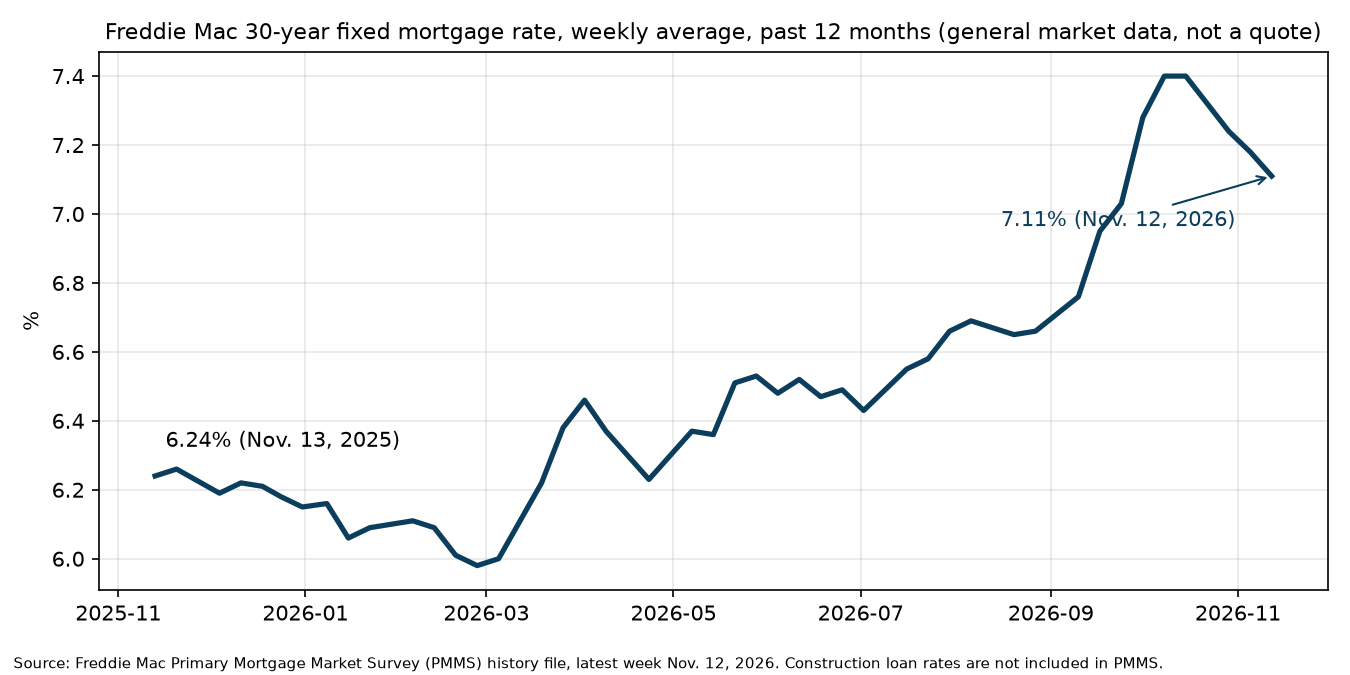
Rates shown are national market averages for general information only. They are not an offer, quote or rate lock, and construction loan rates are not part of the Freddie Mac survey; the roughly 0.75% difference is a general rule of thumb, not a pricing promise. Your actual rate and APR (annual percentage rate, which includes certain loan costs) depend on credit, loan program, property, loan amount and market conditions. Subject to credit approval; not a commitment to lend. Equal Housing Lender.
FAQ
How do construction loan rates compare with regular mortgage rates right now? As of Nov. 12, 2026, Freddie Mac’s average 30-year fixed was 7.11% (Freddie Mac PMMS, Nov. 12, 2026). Construction loans typically run about 0.75% above conventional mortgage rates, depending on the program, borrower and project. These are market averages, not a quote; your rate and APR will differ.
When can I see Milwaukee’s proposed zoning changes? They’re scheduled to post Nov. 16 at engage.milwaukee.gov/housing-tune-up, with public sessions Nov. 17, 19 and 20 (Hoodline, Nov. 13, 2026).
What are pre-approved housing plans? Designs a city reviews in advance so builders who use them face fewer permitting unknowns. Ohio’s effort covers duplexes through sixplexes in Columbus, Cleveland and Cincinnati first; site approvals and zoning still apply (Government Market News, Oct. 16, 2026).
Are lumber prices still falling? Yes. Madison’s index fell for a sixth straight week to $444 per 1,000 board feet for the week ending Nov. 13, but overall residential construction input prices are up 10.4% from a year ago.
When is the next regional housing data? October housing starts and permits come out Nov. 18, and October new home sales on Nov. 25 (U.S. Census Bureau release schedule).
About the Author
Aaron Meilich is a licensed General Contractor and Construction Mortgage Specialist (NMLS #769327, CA Contractor License #1010953), based in Sacramento, California. He has about 30 years in construction financing and has also been building homes for the last 7 years. He originates VA, Conventional, and Jumbo one-time-close construction-to-permanent loans, and helps families and builders nationwide. Licensed in all U.S. states except Hawaii and New York. Call (916) 798-3000 or get prequalified.
Here’s what I like most for Midwest buyers who want a more comfortable, more resilient home: when features like a whole-home battery, a fresh-air ventilation system or radon mitigation are designed into the plans from day one, they can typically be financed as part of the same construction-to-permanent loan, instead of being added later with a separate loan or a credit card. (Features must be in the approved plans and budget and are subject to appraisal and program guidelines; subject to credit approval.)
Aaron Meilich, NMLS #769327 | CA Contractor License #1010953 | Equal Housing Lender. Subject to credit approval; not a commitment to lend. Licensing & disclosures: www.FundandBuild.com. For licensing information, visit www.nmlsconsumeraccess.org.
Featured Construction Loan Programs
Nationwide lending solutions customized to your build
Licensed in all U.S. states except Hawaii and New York.
Single closing with upfront rate lock and automated 30-year conversion.
VA, Conventional, and Jumbo one-time close construction loans.
Zero down payment, no monthly PMI custom home builds for veterans.
Ready to Structure Your Construction Loan?
Calculate your monthly construction interest, evaluate project equity, and get pre-qualified in under 3 minutes.