Midwest Builders: Modular Homes in Chicago Heights, a New Neighborhood Up North, and Towns Paid to Fix Zoning (Week of Nov. 9, 2026)
NMLS #769327 | CA Contractor License #1010953 | Licensed General Contractor
Short answer: Cook County’s modular homes pilot has eight factory-built homes under construction in Chicago Heights, with plans for 600 more over five to seven years. Manistee Township, Michigan, approved its first new neighborhood in decades using a tax-increment plan on vacant land, and Dane County, Wisconsin, handed four towns $279,750 to rewrite zoning and permitting rules. Lumber keeps falling, but a Midwest dealer’s composites are still above a year ago and a wave of manufacturer price increases lands Nov. 16 through Jan. 4.
Construction Tech: Modular Homes Go to Work in Cook County
The Cook County Modular Homes Pilot Program is building eight homes at Bethel Renaissance in Chicago Heights, priced from $299,000 to $375,000, with a plan for 600 homes in the community over the next five to seven years. Chicago Heights is one of three pilot communities, and qualified buyers can get up to $75,000 in assistance. The county’s housing deputy director described it as gap financing: the buyer gets a first mortgage they can afford, and the program covers the difference up to the cap. Sale proceeds roll back into the next phase. One first-time buyer told CBS he expects to move in by January (CBS Chicago, Nov. 5, 2026).
What I take from it as a lender: factory-built homes are moving from a niche into public programs. If you’re thinking about modular for a client, talk to the lender before you sign with the factory. Deposits, delivery and set day have to line up with how the loan releases money.
Land and Zoning: Michigan and Wisconsin
Manistee Township, Mich. Edwin Allen Homes and Michigan Housing Partnership got approval for an 86-home neighborhood (72 single-family homes and 14 duplexes) on about 27.8 acres of long-vacant land north of the Munson Healthcare Manistee Hospital. The county planning director said the area hasn’t seen a neighborhood like it “in a very long time.” It’s financed with a non-environmental brownfield tax increment plan: the developer pays for construction and infrastructure up front and is reimbursed from the added property taxes for 25 years starting in 2027. Duplexes go first, with groundbreaking expected in spring 2027; 19 units will be income-restricted for 10 years. A 2023 study put Manistee County’s for-sale housing need at 1,377 units (mlive, Nov. 5, 2026).
Dane County, Wis. Four municipalities will split $279,750 in HUD-funded grants to remove barriers to housing: Sun Prairie ($150,000), Deerfield ($60,000), Monona ($51,000) and Waunakee ($18,750). The money pays for zoning and building code updates, permitting and approval changes, and land-use planning. A second round of about $720,000 is open to municipalities (Channel3000, Nov. 8, 2026). If you build in Dane County, it’s a good time to tell your town planners which rules cost you the most time.
Lumber and Material Prices This Week
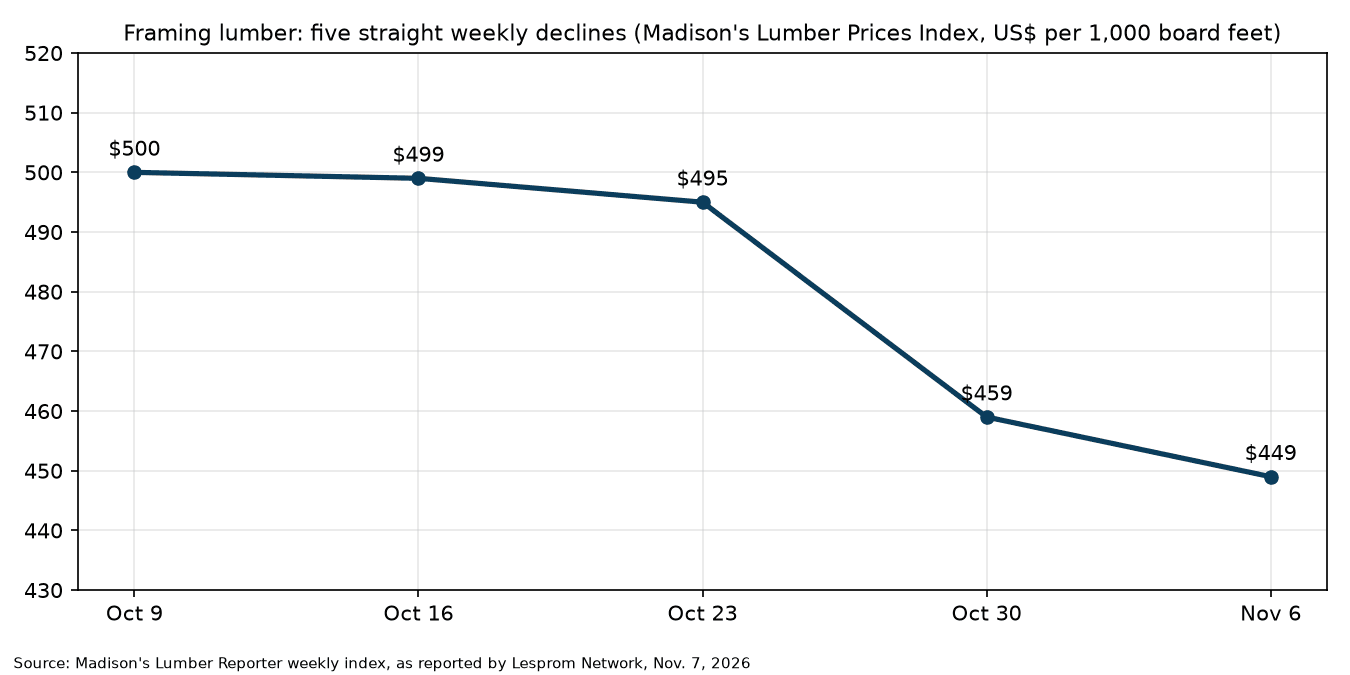
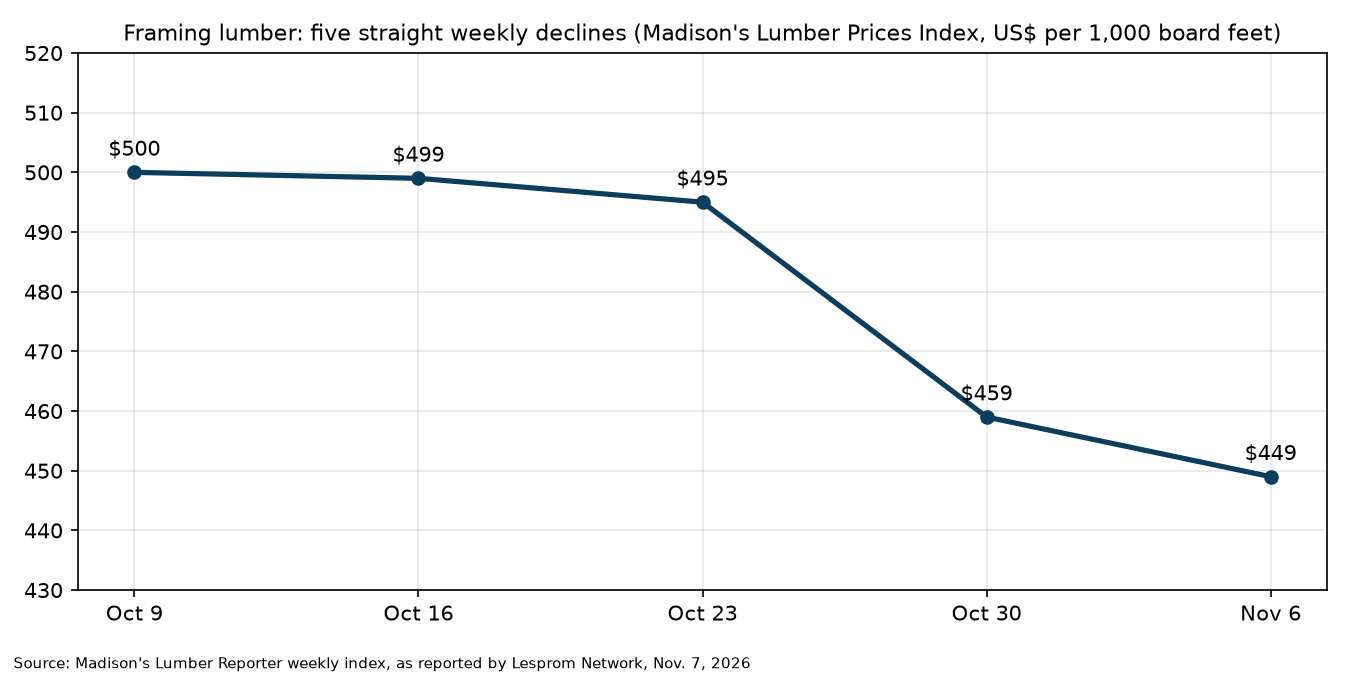
Madison’s Lumber Prices Index fell to $449 per 1,000 board feet for the week ending Nov. 6, down $10 (2%) on the week and 10% from a month earlier. It was the fifth straight weekly decline (Lesprom Network, Nov. 7, 2026). CME lumber futures closed Friday, Nov. 6 at $500, the lowest close since September 2024 and 6.3% below a year earlier (Lesprom Network, Nov. 8, 2026).
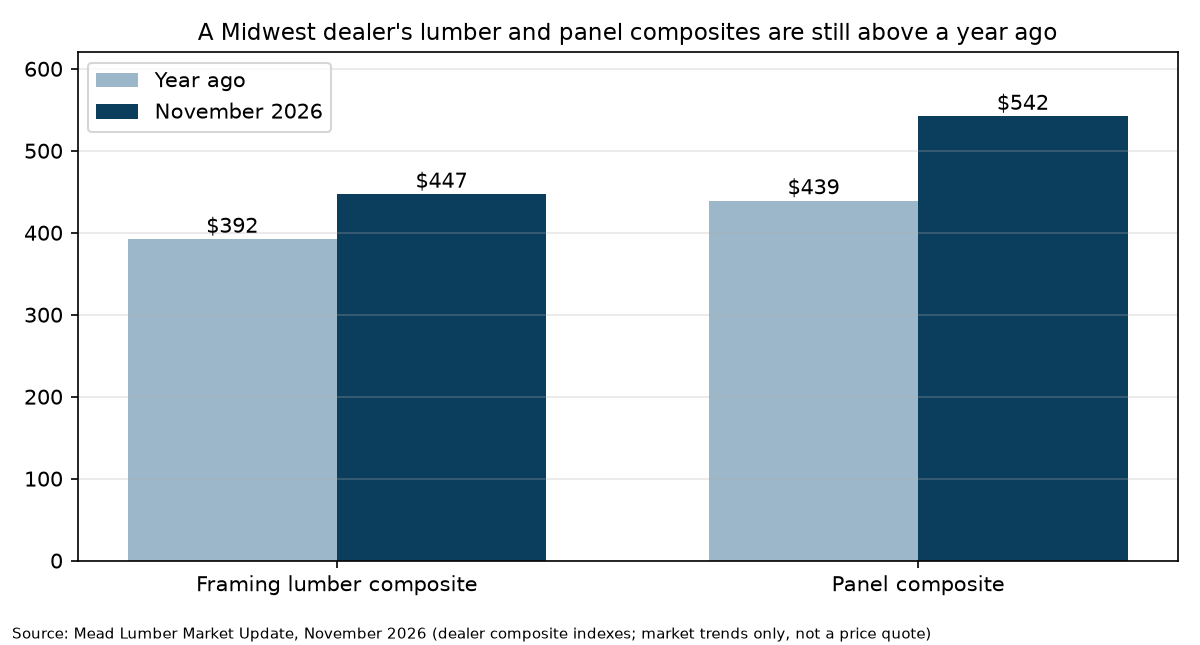
Prices at the yard tell a slightly different story. Mead Lumber’s November update shows its framing lumber composite at $447 versus $392 a year ago, and its panel composite at $542 versus $439. Traders called October “one of the sloppiest markets in recent memory,” with prices down across most framing species (Mead Lumber Market Update, November 2026).
Mead also lists upcoming manufacturer increases: Owens Corning EXP 5% (Nov. 16), Hardie siding 4% to 7% (Nov. 30), Azek decking 3% to 5% (Nov. 30), ClarkDietrich 10% on Dec. 1 and again on Jan. 4, 2027, and Phifer 5% to 10% on Jan. 1. The good news on supply: roofing, insulation and vinyl are in good supply with short lead times, though trucking remains a problem and LP primed and ExpertFinish siding are running 4 to 6 weeks on direct trucks. Mead also notes LP has rearranged its Midwest distribution partners, so confirm where your siding is coming from (Mead Lumber Market Update, November 2026).
Seasonal Best Practices for Midwest Jobsites
An Ohio builder laid out how it keeps building through winter (Wayne Homes, Nov. 5, 2026):
- Tent the foundation below 20°F. When temperatures fall below 20 degrees, foundation work goes under a heated tent; straw or curing blankets protect fresh concrete when overnight lows threaten.
- Ventilate while you heat. Temporary propane heat adds moisture, so windows may be cracked open while drywall compound dries.
- Push weather-sensitive exterior items. Exterior paint, final rough grading and above-grade waterproofing may wait for better conditions. Track them so they aren’t forgotten.
- Budget the winter extras. Snow removal, extra gravel for muddy access and driveway maintenance are real costs. Spell out who pays for heat before and after the permanent furnace is running.
- Use the labor softness. Residential construction employment fell by 16,400 jobs in October, the largest drop since March 2021 (NAHB Eye on Housing, Nov. 6, 2026). Winter can be a good time to lock in subs for spring starts.
Construction Loan Rates: Where the Market Is
As of Nov. 5, 2026, Freddie Mac’s average 30-year fixed rate was 7.18%, down from 7.24% the week before and the third weekly decline in a row (Freddie Mac PMMS, Nov. 5, 2026). The next survey is due Thursday, Nov. 12. In my experience, construction loan rates typically run about 0.75% above conventional mortgage rates, which would put a typical construction loan somewhere around 7.9% as a general market average, depending on the program, borrower and project. For context, the 30-year averaged 7.33% in October, up 47 basis points from September, after touching 7.40% early in the month, its highest level since 2023 (NAHB Eye on Housing, Nov. 3, 2026).
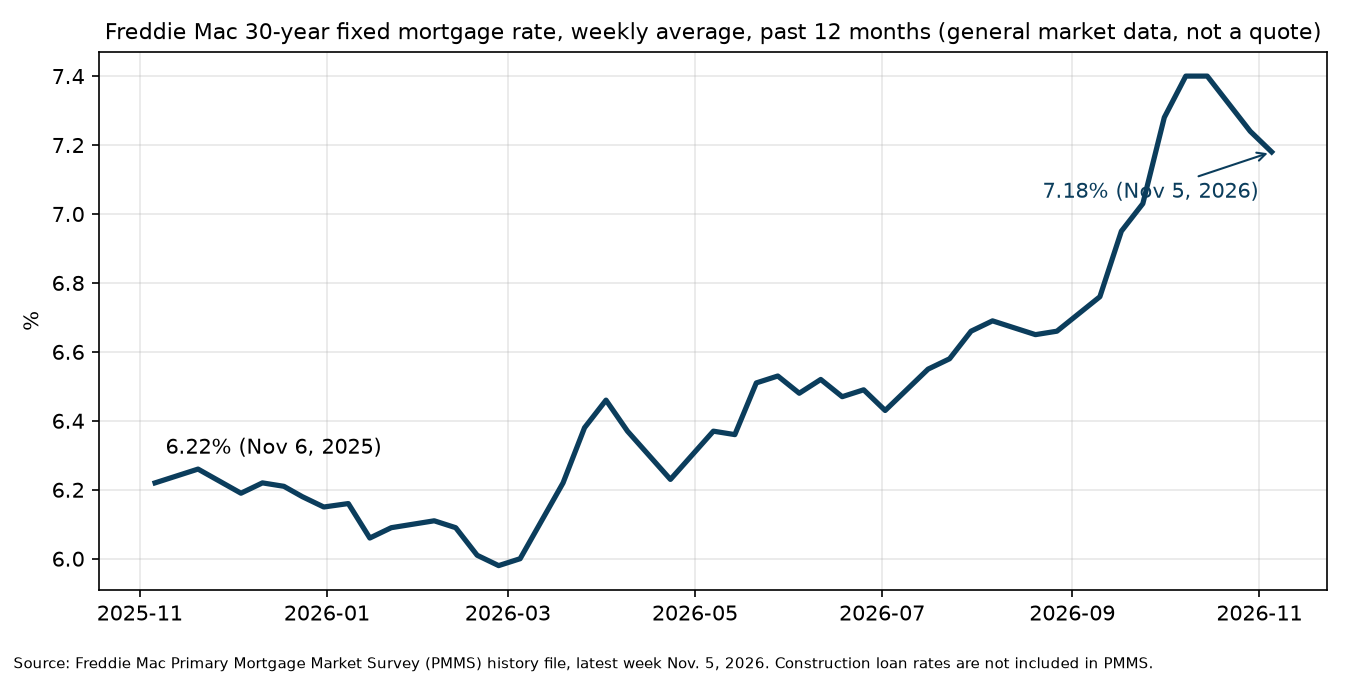
Rates shown are national market averages for general information only. They are not an offer, quote or rate lock, and construction loan rates are not part of the Freddie Mac survey; the roughly 0.75% difference is a general rule of thumb, not a pricing promise. Your actual rate and APR (annual percentage rate, which includes certain loan costs) depend on credit, loan program, property, loan amount and market conditions. Subject to credit approval; not a commitment to lend. Equal Housing Lender.
FAQ
How do construction loan rates compare with regular mortgage rates right now? As of Nov. 5, 2026, Freddie Mac’s average 30-year fixed was 7.18% (Freddie Mac PMMS, Nov. 5, 2026). Construction loans typically run about 0.75% above conventional mortgage rates, depending on the program, borrower and project. These are market averages, not a quote; your rate and APR will differ.
What is the Cook County Modular Homes Pilot Program? A county program that develops factory-built homes in underserved communities and offers qualified buyers up to $75,000 in assistance. Eight homes priced $299,000 to $375,000 are under construction in Chicago Heights (CBS Chicago, Nov. 5, 2026).
How is the Manistee Township neighborhood being financed? Through a brownfield tax increment plan on land with no contamination history. The developer pays the up-front costs and is reimbursed from the increase in property taxes for 25 years starting in 2027 (mlive, Nov. 5, 2026).
Which building products have price increases coming? Per Mead Lumber’s November update: Owens Corning EXP (5%, Nov. 16), Hardie siding (4% to 7%, Nov. 30), Azek decking (3% to 5%, Nov. 30), ClarkDietrich (10% on Dec. 1 and Jan. 4) and Phifer (5% to 10%, Jan. 1).
Can you pour a foundation in a Midwest winter? Yes, with protection. One Ohio builder pours under a heated tent when temperatures are below 20°F and uses curing blankets when overnight lows threaten fresh concrete (Wayne Homes, Nov. 5, 2026).
When is the next regional housing data? October permits and starts come out Nov. 18 and October new home sales on Nov. 25 (U.S. Census Bureau release schedule).
About the Author
Aaron Meilich is a licensed General Contractor and Construction Mortgage Specialist (NMLS #769327, CA Contractor License #1010953), based in Sacramento, California. He has about 30 years in construction financing and has also been building homes for the last 7 years. He originates VA, Conventional, and Jumbo one-time-close construction-to-permanent loans, and helps families and builders nationwide. Licensed in all U.S. states except Hawaii and New York. Call (916) 798-3000 or get prequalified.
Here’s what I like most for the modular projects showing up across the Midwest: a construction-to-permanent loan can often finance a factory-built home the same way it finances a stick-built one, with draws tied to milestones like the factory deposit, delivery and set, and completion, and one loan that becomes the permanent mortgage when the home is done. (Eligibility depends on the home type, factory and program; subject to credit approval.)
Aaron Meilich, NMLS #769327 | CA Contractor License #1010953 | Equal Housing Lender. Subject to credit approval; not a commitment to lend. Licensing & disclosures: www.FundandBuild.com. For licensing information, visit www.nmlsconsumeraccess.org.
Featured Construction Loan Programs
Nationwide lending solutions customized to your build
Licensed in all U.S. states except Hawaii and New York.
Single closing with upfront rate lock and automated 30-year conversion.
VA, Conventional, and Jumbo one-time close construction loans.
Zero down payment, no monthly PMI custom home builds for veterans.
Ready to Structure Your Construction Loan?
Calculate your monthly construction interest, evaluate project equity, and get pre-qualified in under 3 minutes.