Northeast Builders: Massachusetts Narrowly Rejects Smaller Lots, NYC Gets One Permit Door, and New Jersey Opens Its Permit Books (Week of Nov. 16, 2026)
NMLS #769327 | CA Contractor License #1010953 | Licensed General Contractor
Short answer: Massachusetts voters rejected Question 7, which would have allowed single-family homes on 5,000-square-foot lots with public water and sewer, by about 50.6% to 49.4%. New York City voters approved Proposal 4, which replaces roughly 40 separate approvals from 18 city offices with a single Department of Buildings permit hub. New Jersey launched a public view of its state permitting dashboard, and Rhode Island approved a $120 million housing bond. Framing lumber fell for a sixth straight week, but overall construction input costs are still up 10.4% from a year ago.
I’ve spent 30 years in construction lending, and the last 7 building homes as well. Weeks like this one remind me how much of a builder’s schedule is decided at the ballot box and the permit counter, long before anyone pours a footing. Here’s what matters for Northeast builders this week.
Election Fallout: Massachusetts Question 7 Falls Just Short
The Associated Press called Question 7 on Nov. 6. With 99% of the expected vote counted, “no” had 1,288,793 votes (50.65%) to 1,255,840 for “yes” (49.35%) (NBC Boston, Nov. 6, 2026). The measure would have let a single-family home go on any residential lot of at least 5,000 square feet with 50 feet of frontage and public water and sewer.
- Who voted how: the 26 most densely populated municipalities voted yes, with Somerville highest at 76%. Boston backed it heavily but would have been exempt under its separate zoning law (MassLive, Nov. 8, 2026).
- What it would have meant: Tufts’ Center for State Policy Analysis estimated 350 to 1,200 new homes a year, about 750 on average, over the first 10 years, with roughly 200,000 lots newly eligible (MassLive, Nov. 8).
- Where the lots are: one analysis counted the largest potential gains in towns such as Chelmsford, Billerica and Tewksbury, and found support fell as the number of potential new lots in a town rose (CommunityScale, Nov. 11, 2026).
NAHB, which helped fund the campaign, called it one of two key defeats in an otherwise strong year for housing measures (NAHB, Nov. 11, 2026). Supporters told MassLive the conversation isn’t over. For builders, minimum lot sizes stay a town-by-town question, so infill and teardown sites on existing lots remain the most practical path to new single-family product in much of eastern Massachusetts.
Permitting: One Door in New York City, an Open Dashboard in New Jersey
New York City approved all five charter measures. Under Proposal 4, builders who now collect about 40 approvals across 18 city offices will file through one Department of Buildings portal, and waterfront permits move to DOB. Proposal 3 could cut sales of small, undevelopable city lots to adjacent owners from about seven months to roughly 90 days (CRE Daily, citing Bisnow, Nov. 9, 2026). The real test is implementation: watch how quickly DOB actually launches the portal.
New Jersey opened its books. The public view of the state’s Permitting Dashboard Pilot at Permits.NJ.gov now lets anyone follow pilot projects through each review step. Since January, DOT’s backlog of Minor Access Permits, which small and mid-size housing projects often need for driveways onto state highways, fell 83%, and DEP’s Freshwater Wetlands Letter of Interpretation backlog fell 74%. The Department of Community Affairs is building a single online construction permitting system covering the full permit lifecycle, from application to certificate of occupancy (Office of the Governor of New Jersey, Oct. 28, 2026).
Rhode Island voters approved a $120 million housing bond, with $25 million earmarked for homeownership housing, and Providence approved another $25 million for its Housing Trust Fund. The state permitted 3,778 homes in 2025, up from 2,818 in 2024, and ADU permits rose 76% to 287 (Providence Preservation Society, Nov. 12, 2026).
A new UNLV study of Census data found Rhode Island, New York and Massachusetts still near the bottom on permits per resident but posting notable gains this year, while Connecticut and Vermont each fell about 18% (Realtor.com, Nov. 9, 2026).
Market Check
Existing home sales hit a 16-year low nationally in October, but the Northeast held steady month over month and was down only 4.1% from a year earlier, the smallest decline of any region (NAHB Eye on Housing, Nov. 12, 2026). Builder credit is still tight. NAHB’s survey of builders and developers shows conditions on land, development and construction loans tightened for the 19th straight quarter in Q3 2026. The same survey found that 32% of builders who built single-family homes in Q3 financed some of them with a construction-to-permanent (one-time close) loan made to the home buyer, and on average 58% of those builders’ homes were financed that way (NAHB Eye on Housing, Nov. 13, 2026).
Construction Tech: GAO Weighs In
A new Government Accountability Office technology assessment looks at off-site construction, automated lumber cutting and planning software, and notes that more than 20,000 jurisdictions administer residential building codes, a major hurdle to scaling new methods. Among its 14 policy options: building-code reciprocity for off-site-built homes and pre-approved housing design libraries (U.S. GAO, GAO-27-108037, Nov. 10, 2026).
Design Note: Kitchens Get Zoned, Mudrooms Move In
The National Kitchen & Bath Association’s 2027 trends survey of 800-plus design pros (released from Bethlehem, Pa.) points away from fully open layouts toward defined zones, partial walls and back kitchens. Ninety-four percent expect attached mudrooms to grow in popularity, a natural fit for Northeast winters, and climate-resilience features like leak detection, automatic water shut-off valves and backup power are moving up the list (Kitchen & Bath Design News, Nov. 5, 2026).
Lumber and Material Prices This Week
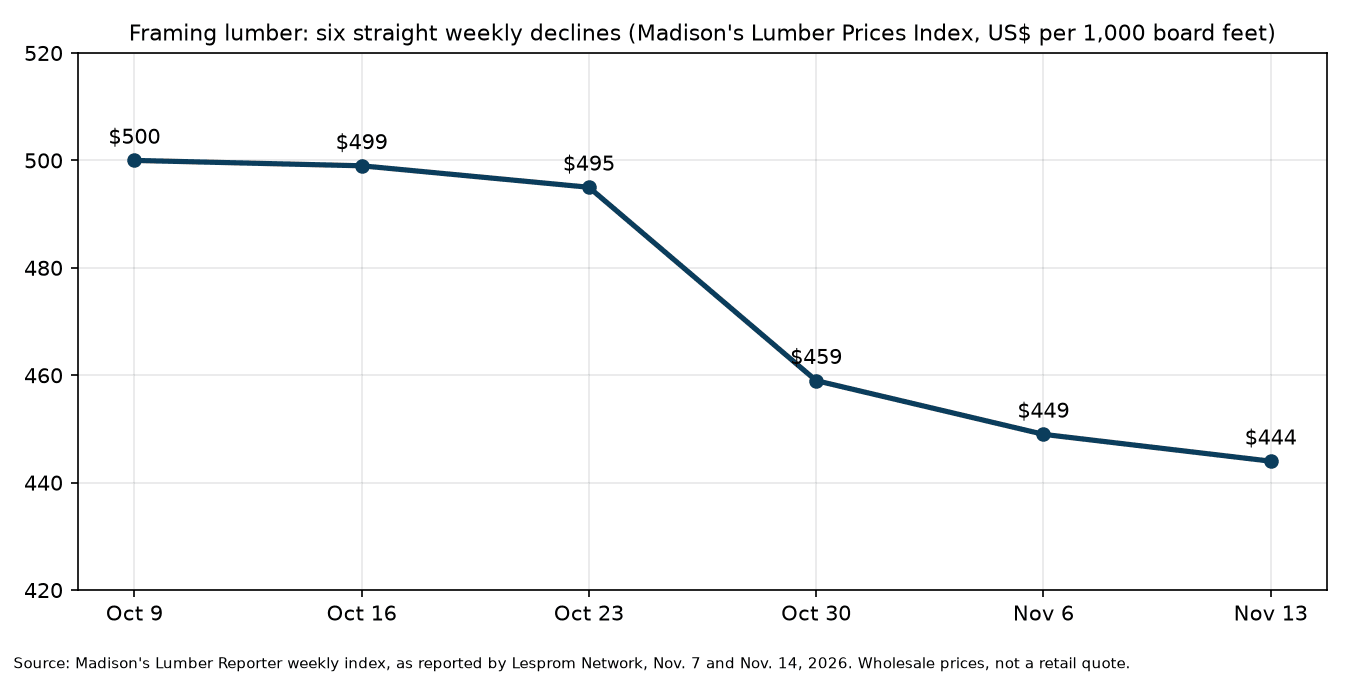
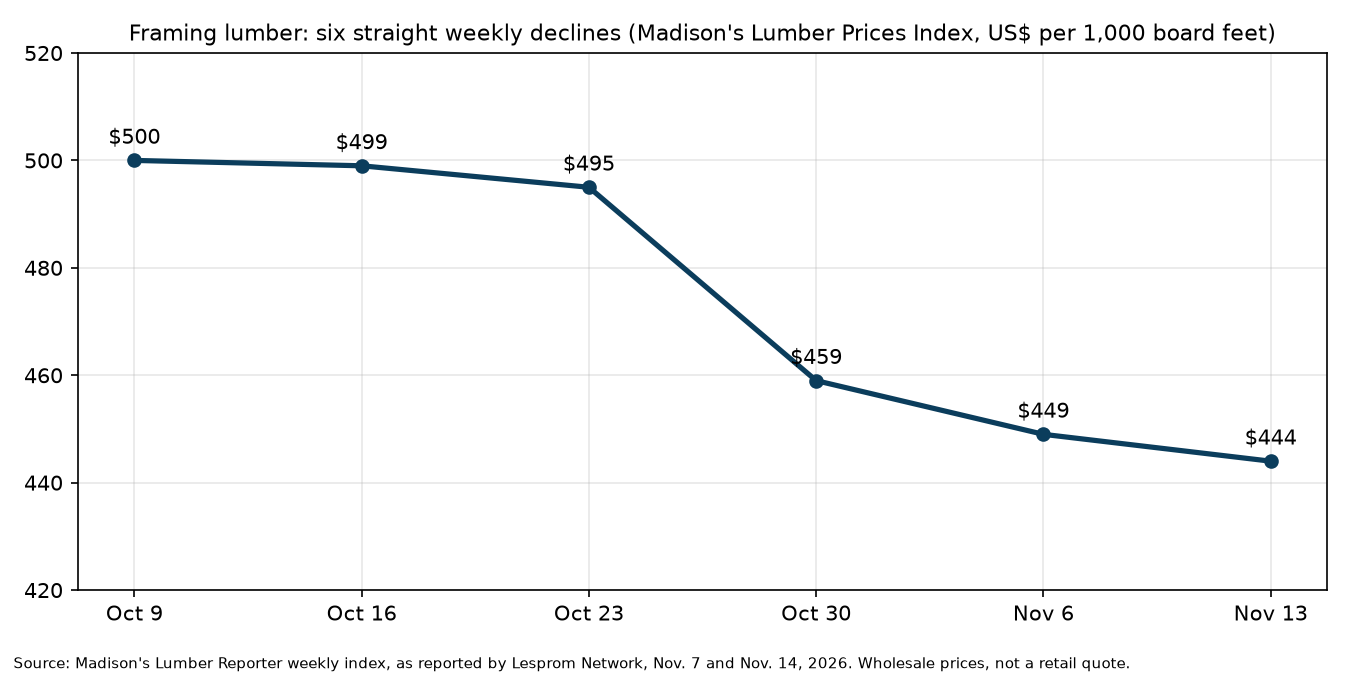
Madison’s Lumber Prices Index slipped to $444 per 1,000 board feet for the week ending Nov. 13, down $5 (1%) on the week and $51 (10%) from a month earlier. It was the sixth straight weekly decline (Lesprom Network, Nov. 14, 2026; Madison’s Lumber Reporter, Nov. 13, 2026).
The broader cost picture is less friendly. Prices for all inputs to new residential construction were up 0.3% in October and 10.4% from a year earlier. Building materials alone rose 0.5% on the month and 5.8% on the year, softwood plywood is up 24.5%, and diesel fuel, even after a 4.6% monthly drop, is up 115.2% from a year ago (NAHB Eye on Housing, Nov. 13, 2026).
Seasonal Best Practices for Northeast Jobsites
NOAA’s winter outlook, shaped by a very strong El Niño, favors warmer-than-average temperatures for much of the East and wetter-than-average conditions along the Eastern Seaboard from December through February (NOAA Winter Outlook, Oct. 15, 2026 (via US Harbors)). That doesn’t mean no cold snaps. From my own jobsites, here’s what I’d plan for:
- Expect more rain and mixed precipitation, not just snow. Get gutters, downspouts and temporary drainage working early, and keep water away from open foundations.
- Never pour on frozen ground. Protect fresh concrete with blankets or heated enclosures and follow your ready-mix supplier’s cold-weather recommendations.
- Dry in before the holidays if you can. Sheathing, roof underlayment, wrap and windows turn the job into interior work.
- Price winter conditions into the budget, including temporary heat, snow removal and enclosures, so they don’t come out of the contingency.
- Use slower weeks to line up spring trades. Residential construction employment fell by 16,400 jobs in October, the largest monthly drop since March 2021 (NAHB Eye on Housing, Nov. 6, 2026).
Construction Loan Rates: Where the Market Is
As of Nov. 12, 2026, Freddie Mac’s average 30-year fixed rate was 7.11%, down from 7.18% the week before, the fourth weekly decline in a row and the lowest level in seven weeks. A year ago it was 6.24% (Freddie Mac PMMS, Nov. 12, 2026). The next survey is due Thursday, Nov. 19. In my experience, construction loan rates typically run about 0.75% above conventional mortgage rates, which would put a typical construction loan somewhere around 7.9% as a general market average, depending on the program, borrower and project. For context, the 30-year averaged 7.33% in October after touching 7.40% early in the month, its highest level since 2023 (NAHB Eye on Housing, Nov. 3, 2026).
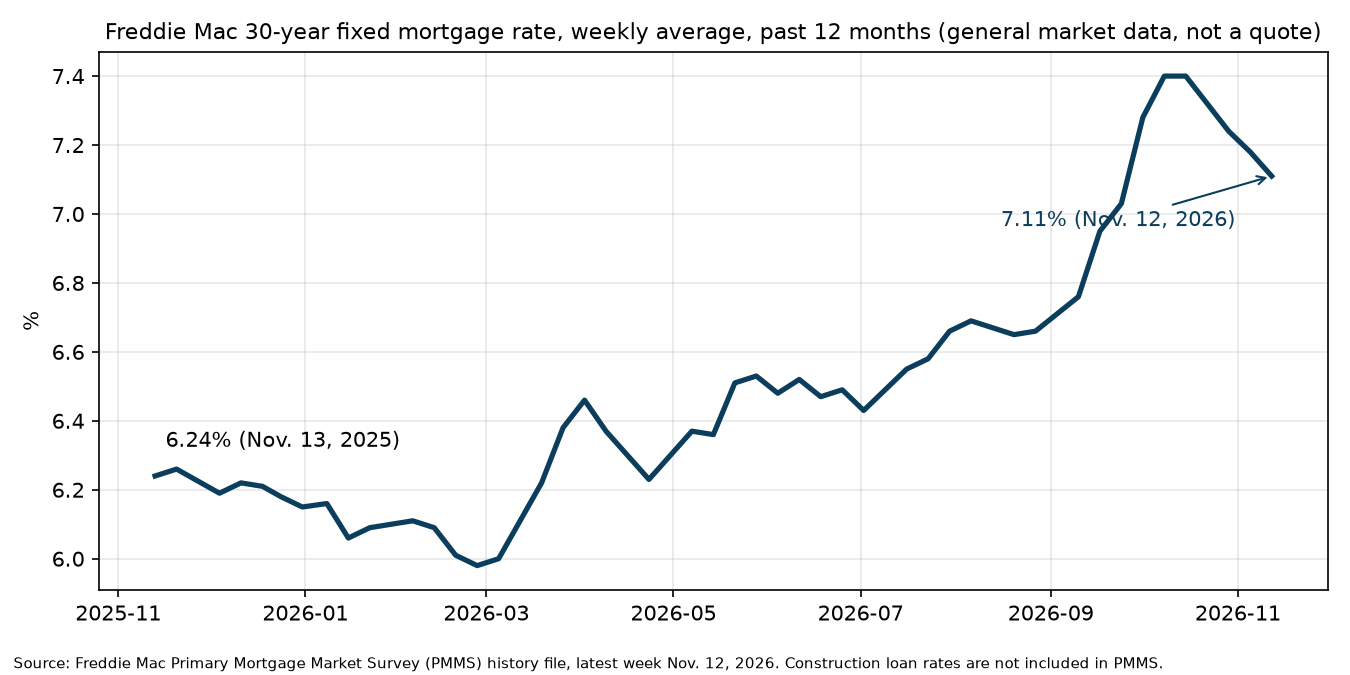
Rates shown are national market averages for general information only. They are not an offer, quote or rate lock, and construction loan rates are not part of the Freddie Mac survey; the roughly 0.75% difference is a general rule of thumb, not a pricing promise. Your actual rate and APR (annual percentage rate, which includes certain loan costs) depend on credit, loan program, property, loan amount and market conditions. Subject to credit approval; not a commitment to lend. Equal Housing Lender.
FAQ
How do construction loan rates compare with regular mortgage rates right now? As of Nov. 12, 2026, Freddie Mac’s average 30-year fixed was 7.11% (Freddie Mac PMMS, Nov. 12, 2026). Construction loans typically run about 0.75% above conventional mortgage rates, depending on the program, borrower and project. These are market averages, not a quote; your rate and APR will differ.
Did Massachusetts Question 7 pass? No. With 99% of the expected vote counted, it failed 50.65% to 49.35% (NBC Boston, Nov. 6, 2026).
What does New York City’s Proposal 4 do? It replaces about 40 approvals across 18 city offices with a single Department of Buildings permit portal (CRE Daily, Nov. 9, 2026).
Where can I see New Jersey permit progress? At Permits.NJ.gov, which shows pilot projects moving through DEP, DOT and DCA review (NJ Governor’s Office, Oct. 28, 2026).
When is the next regional housing data? October housing starts and permits come out Nov. 18, and October new home sales on Nov. 25 (U.S. Census Bureau release schedule).
About the Author
Aaron Meilich is a licensed General Contractor and Construction Mortgage Specialist (NMLS #769327, CA Contractor License #1010953), based in Sacramento, California. He has about 30 years in construction financing and has also been building homes for the last 7 years. He originates VA, Conventional, and Jumbo one-time-close construction-to-permanent loans, and helps families and builders nationwide. Licensed in all U.S. states except Hawaii and New York. Call (916) 798-3000 or get prequalified.
Here’s what I like most for Northeast families sitting on an older house and a good lot: on many construction-to-permanent programs, tearing down the existing home and building new can be financed as one project, with demolition, construction and the permanent mortgage in a single loan, instead of piecing together separate financing for each step. With Question 7 failing, building new on a lot you already own is often the most practical path. (Eligibility, appraisal and local demolition permit requirements vary by program and property; subject to credit approval.)
Aaron Meilich, NMLS #769327 | CA Contractor License #1010953 | Equal Housing Lender. Subject to credit approval; not a commitment to lend. Licensing & disclosures: www.FundandBuild.com. For licensing information, visit www.nmlsconsumeraccess.org.
Featured Construction Loan Programs
Nationwide lending solutions customized to your build
Licensed in all U.S. states except Hawaii and New York.
Single closing with upfront rate lock and automated 30-year conversion.
VA, Conventional, and Jumbo one-time close construction loans.
Zero down payment, no monthly PMI custom home builds for veterans.
Ready to Structure Your Construction Loan?
Calculate your monthly construction interest, evaluate project equity, and get pre-qualified in under 3 minutes.