Northeast Builders: Massachusetts Says No to Smaller Lots, Rhode Island Says Yes to $120 Million, and the 40°F Rule Kicks In (Week of Nov. 9, 2026)
NMLS #769327 | CA Contractor License #1010953 | Licensed General Contractor
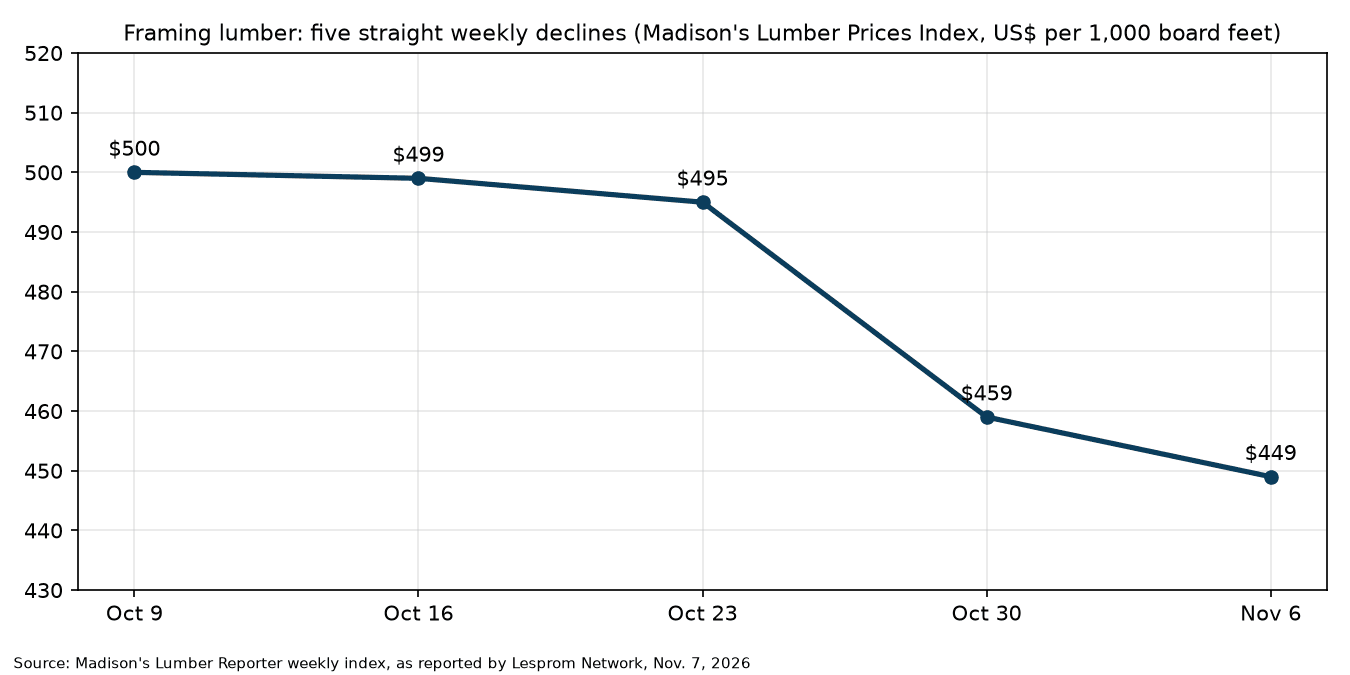
Short answer: Massachusetts voters narrowly rejected Question 7, which would have allowed single-family homes on 5,000-square-foot lots statewide, while Rhode Island voters approved a $120 million housing bond with at least $25 million set aside for homeownership. Framing lumber fell for a fifth straight week to $449, and with overnight lows already in the 30s across New England and New York, cold-weather rules for concrete, masonry and stucco are now in play.
I’ve been watching election week closely, because ballot results tend to show up in my builders’ permit files a year or two later. Here’s what changed in the Northeast and what I’d do about it.
Regulation: What the Election Did (and Didn’t) Change
Massachusetts Question 7 failed narrowly. The Associated Press called it on Friday, Nov. 6, three days after the polls closed, with “no” at 50.6%. The measure would have required every city and town except Boston to allow a single-family home on residentially zoned lots of at least 5,000 square feet with 50 feet of frontage and public water and sewer. Most land zoned for single-family homes in the state requires 1 to 2 acres, according to the National Zoning Atlas. Estimates of what it would have produced ranged from 350 to 1,200 net new homes a year (Tufts) to 2,200 to 5,700 (the campaign) (WBUR, Nov. 6, 2026). Minimum lot sizes stay a local decision, so your land strategy in Massachusetts doesn’t change: buildable lots in sewered towns remain scarce and valuable.
A smaller Massachusetts change is already helping. Under amendments to the state zoning act, some preexisting nonconforming structures (nonconforming because of lot size, frontage, coverage or floor-area ratio) can now be extended or altered without a zoning board finding, as long as the change meets current height, story and setback rules. Applicants are protected once they’ve applied for a building permit; they don’t need it in hand (Citizen Portal, Orleans, Mass., Nov. 5, 2026). For additions and tear-down-rebuild projects on older Cape and suburban lots, that can mean one less public hearing.
Rhode Island Question 2 passed with 61.1%. The $120 million bond can fund pre-development, new construction, property acquisition and infrastructure. At least $25 million must go to homeownership housing, and the state expects construction on funded projects to begin in 2028 (Realtor.com, Nov. 3, 2026; Inman, Nov. 4, 2026).
Maine keeps hearing the same message. At a Portland housing forum, the Maine Affordable Housing Coalition said Portland saw 7% housing growth but a 56% rent increase from 2019 to 2026, and Pew’s Alex Horowitz pointed to zoning, building codes and permitting as the bottlenecks (WGME, Nov. 5, 2026).
Design Note: Three-Season Rooms Are Back
The American Institute of Architects’ latest Home Design Trends Survey found sunrooms and three-season porches were the fastest climber among special-function rooms: a net 25% of residential architects reported rising popularity, up from 6% a year earlier. Heated exterior space rose to a net 16% from 12%, and outdoor living areas led the list at 51% (AIA Home Design Trends Survey, Q3 2026 report). In a region where the outdoor season is short, a well-insulated three-season room is a feature clients will ask about. Price it early so it’s in the construction budget and the appraisal, not a change order halfway through.
Lumber and Material Prices This Week
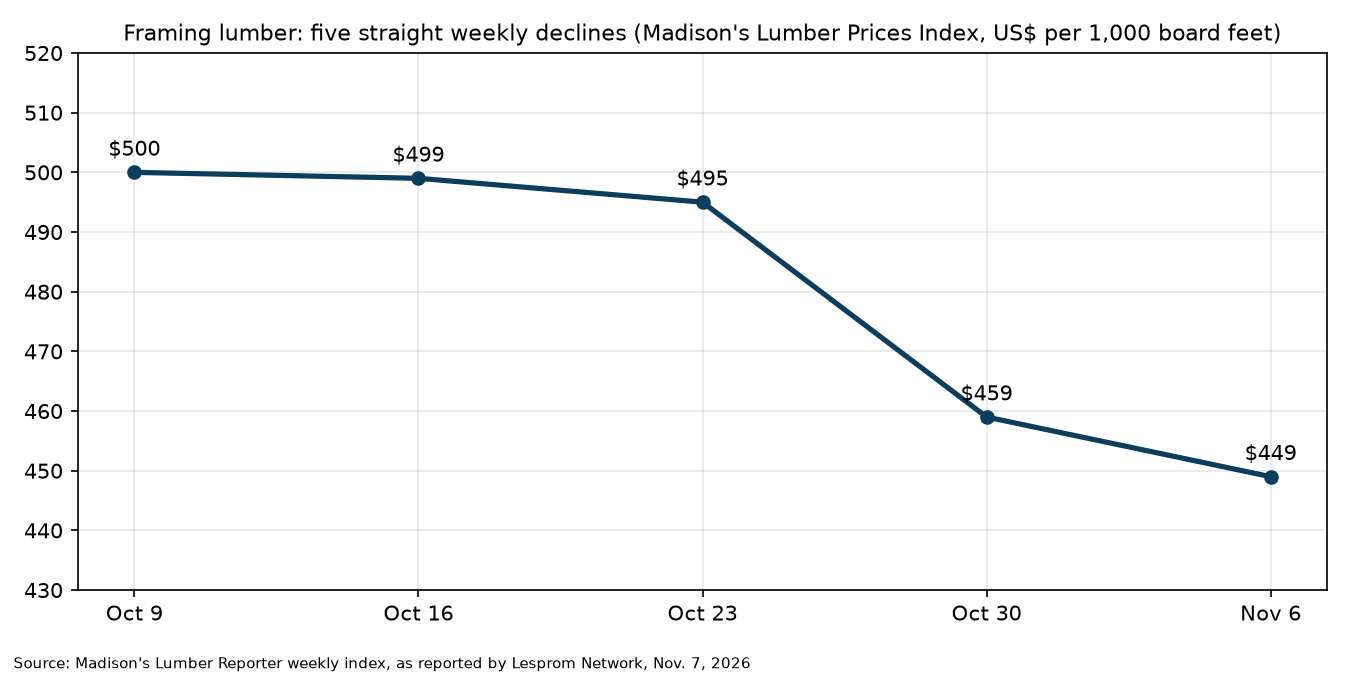
Madison’s Lumber Prices Index fell to $449 per 1,000 board feet for the week ending Nov. 6, down $10 (2%) on the week and 10% from a month earlier. It was the fifth straight weekly decline (Lesprom Network, Nov. 7, 2026). CME lumber futures closed Friday, Nov. 6 at $500, the lowest close since September 2024 and 6.3% below a year earlier (Lesprom Network, Nov. 8, 2026).
Lumber isn’t the whole story. Manufacturers have announced a round of increases on other products: Owens Corning EXP 5% (Nov. 16), Hardie siding 4% to 7% and Azek decking 3% to 5% (Nov. 30), and ClarkDietrich 10% on Dec. 1 with another 10% on Jan. 4, 2027 (Mead Lumber Market Update, November 2026). UBS estimated in September that tariffs then in place add about $8,200 to the cost of every home (CRE Daily, Nov. 2, 2026). My take: lock framing packages while lumber is soft, and get siding and trim orders in before the Nov. 30 increases where you can.
Seasonal Best Practices: The 40°F Rule
A Boston-area engineering firm laid out the cold-weather standards well this fall (Duffy Engineering, Oct. 30, 2026):
- 40°F is the trigger. ACI 306R-16 defines cold weather as air temperature at or expected to fall below 40°F during the protection period, and the masonry specification (TMS 602) uses the same trigger.
- Late fall is the riskiest time. The dangerous pour isn’t in January, when everyone protects the work. It’s a mild November afternoon followed by a hard overnight freeze. ACI recommends protecting all fresh concrete from freezing for at least the first 24 hours.
- Never pour on frozen ground. Thaw and recompact frozen subgrade and keep forms free of frost and ice.
- Stucco and EIFS need 40°F and rising. The building code requires cement plaster to stay above 40°F during application and for 48 hours afterward unless it’s protected.
- Choose heaters carefully. Unvented direct-fired heaters add carbon dioxide and carbon monoxide to enclosures; indirect-fired, hydronic or electric heat avoids softening fresh concrete surfaces and protects workers.
- Use winter for paperwork. Surveys, design, permitting and bidding don’t care about the weather. A project that’s fully designed and contracted by March is the one that mobilizes first in spring.
On the labor side, residential construction employment fell by 16,400 jobs in October, the largest monthly decline since March 2021 (NAHB Eye on Housing, Nov. 6, 2026). That can make good subs easier to book this winter.
Construction Loan Rates: Where the Market Is
As of Nov. 5, 2026, Freddie Mac’s average 30-year fixed rate was 7.18%, down from 7.24% the week before and the third weekly decline in a row (Freddie Mac PMMS, Nov. 5, 2026). The next survey is due Thursday, Nov. 12. In my experience, construction loan rates typically run about 0.75% above conventional mortgage rates, which would put a typical construction loan somewhere around 7.9% as a general market average, depending on the program, borrower and project. For context, the 30-year averaged 7.33% in October, up 47 basis points from September, after touching 7.40% early in the month, its highest level since 2023 (NAHB Eye on Housing, Nov. 3, 2026).
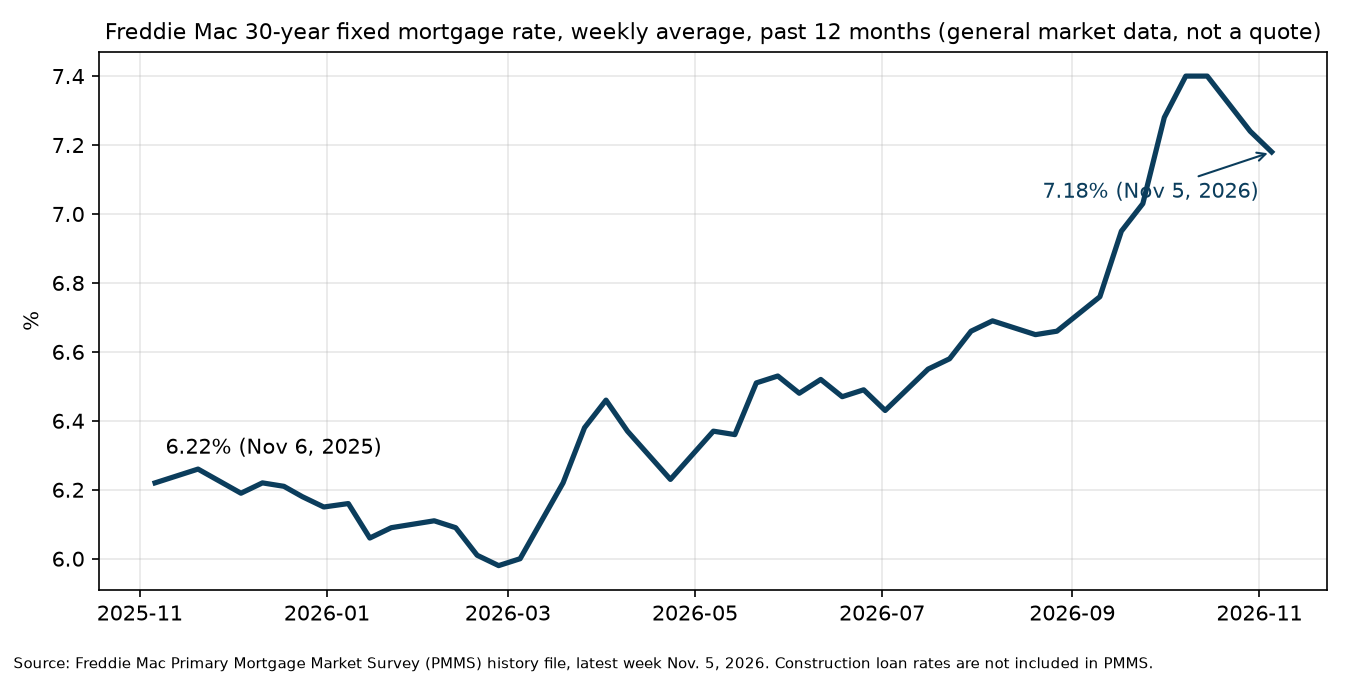
Rates shown are national market averages for general information only. They are not an offer, quote or rate lock, and construction loan rates are not part of the Freddie Mac survey; the roughly 0.75% difference is a general rule of thumb, not a pricing promise. Your actual rate and APR (annual percentage rate, which includes certain loan costs) depend on credit, loan program, property, loan amount and market conditions. Subject to credit approval; not a commitment to lend. Equal Housing Lender.
FAQ
How do construction loan rates compare with regular mortgage rates right now? As of Nov. 5, 2026, Freddie Mac’s average 30-year fixed was 7.18% (Freddie Mac PMMS, Nov. 5, 2026). Construction loans typically run about 0.75% above conventional mortgage rates, depending on the program, borrower and project. These are market averages, not a quote; your rate and APR will differ.
Did Massachusetts pass Question 7? No. Voters narrowly rejected it, with “no” at 50.6% when the AP called the race on Nov. 6, 2026. Local minimum lot sizes remain in place (WBUR, Nov. 6, 2026).
What does Rhode Island’s Question 2 fund? $120 million in bonds for pre-development, new construction, property acquisition and infrastructure, with at least $25 million for homeownership housing. Funded construction is expected to start in 2028 (Realtor.com, Nov. 3, 2026).
When do cold-weather concrete rules apply? Under ACI 306R-16, when air temperature falls, or is expected to fall, below 40°F during the protection period (Duffy Engineering, Oct. 30, 2026).
Are lumber prices still falling? Yes, as of Nov. 6. Madison’s index fell to $449 per 1,000 board feet, its fifth straight weekly decline, and futures closed at a two-year low of $500.
When is the next regional housing data? The Census Bureau releases October permits and starts on Nov. 18 and October new home sales on Nov. 25 (U.S. Census Bureau release schedule).
About the Author
Aaron Meilich is a licensed General Contractor and Construction Mortgage Specialist (NMLS #769327, CA Contractor License #1010953), based in Sacramento, California. He has about 30 years in construction financing and has also been building homes for the last 7 years. He originates VA, Conventional, and Jumbo one-time-close construction-to-permanent loans, and helps families and builders nationwide. Licensed in all U.S. states except Hawaii and New York. Call (916) 798-3000 or get prequalified.
Here’s what I like most for winter builds in the Northeast: on the construction loans I work with, money is released in draws, and before each draw is paid an inspector confirms the work is actually in place. When weather slows a job and progress gets harder to eyeball, that independent check protects the homeowner and keeps everyone on the same page about what’s been built. (Inspection and draw procedures vary by program; subject to credit approval.)
Aaron Meilich, NMLS #769327 | CA Contractor License #1010953 | Equal Housing Lender. Subject to credit approval; not a commitment to lend. Licensing & disclosures: www.FundandBuild.com. For licensing information, visit www.nmlsconsumeraccess.org.
Featured Construction Loan Programs
Nationwide lending solutions customized to your build
Licensed in all U.S. states except Hawaii and New York.
Single closing with upfront rate lock and automated 30-year conversion.
VA, Conventional, and Jumbo one-time close construction loans.
Zero down payment, no monthly PMI custom home builds for veterans.
Ready to Structure Your Construction Loan?
Calculate your monthly construction interest, evaluate project equity, and get pre-qualified in under 3 minutes.