South Builders: Charleston Moves to Raise Permit Fees 50%, Dallas Drafts Smaller Lots, and Austin Eases Plan Review (Week of Nov. 16, 2026)
NMLS #769327 | CA Contractor License #1010953 | Licensed General Contractor
Short answer: Charleston City Council unanimously approved the first reading of an ordinance that would raise building permit fees about 50% starting Jan. 1. Dallas released the first public draft of its first major zoning rewrite in more than 40 years, aimed at smaller homes on smaller lots. Austin is taking comments through Nov. 27 on a proposal to let triplexes and fourplexes under 6,000 square feet skip commercial-style building code review. Florida permits are down 4% through Q3, but three regions are up. Framing lumber fell for a sixth straight week, while overall construction input costs are still up 10.4% from a year ago.
I’ve been in construction lending for 30 years and building homes myself for the last 7. When fees, codes and plan-review rules change, the numbers on a builder’s bid change with them, and so does the loan. Here’s what Southern builders should have on their radar this week.
Fees: Charleston’s Proposed 50% Increase
Charleston City Council approved the first reading on Nov. 10. The new fee schedule would take effect Jan. 1, the first increase in five years, and also covers commercial work, demolitions, pools and renovations. The city says its fees no longer cover the cost of plan review, permits and inspections. Under the proposal, the total building permit fee for a project costing $100,001 to $500,000 would be $2,343.50 in January, up from $1,117 in 2019. One local builder said permits plus all four trades on a recent $500,000 home came to about $5,000, and would climb above $6,000 under the new schedule (The Post and Courier, Nov. 13, 2026).
Builders quoted in the story asked for something in return, like one-day inspections and faster plan reviews. My advice: if you’re bidding Charleston jobs that will permit after Jan. 1, update your soft-cost line now so the budget your client finances matches reality.
Zoning and Codes: Dallas and Austin
Dallas released Development Code Public Draft #1 on Nov. 6. Goals include expanding housing options and affordability, simplifying mixed-use zoning and separating heavy industrial uses from neighborhoods. Public open houses, workshops and virtual sessions start Nov. 18 and run through January 2027 (City of Dallas, Nov. 6, 2026). The 400-page draft aims to allow smaller homes on smaller lots; a second draft is due in spring, and a council vote could come as early as August 2027, though council members are split on where denser duplexes belong (CRE Daily, Nov. 13, 2026).
Austin would stop requiring International Building Code (commercial-style) review for three- and four-unit buildings under 6,000 square feet. Fire separations, shared-exit protections and sprinklers would still apply. Written comments are open through Nov. 27, and staff plan to take the amendment to City Council in December (Realtor.com, Nov. 2, 2026).
Texas politics: after a Democratic sweep of statewide offices, the Texas Association of Builders’ CEO told Realtor.com that housing is “neither D nor R. It’s H for housing,” and the industry hopes to keep its supply agenda moving. Texas issues more permits than any other state, 14.6% of the national total (Realtor.com, Nov. 6, 2026).
Market Check: Carolinas Lead, Big Sun Belt States Slow
A UNLV study of Census data for the first eight months of 2026 ranked South Carolina first in permits per resident (6.07 per 1,000, up 5%) and North Carolina third (5.77). Florida, Texas, Arizona and Oklahoma were among states whose permitting pace slowed, although Florida and Texas remain top-10 states by volume (Realtor.com, Nov. 9, 2026).
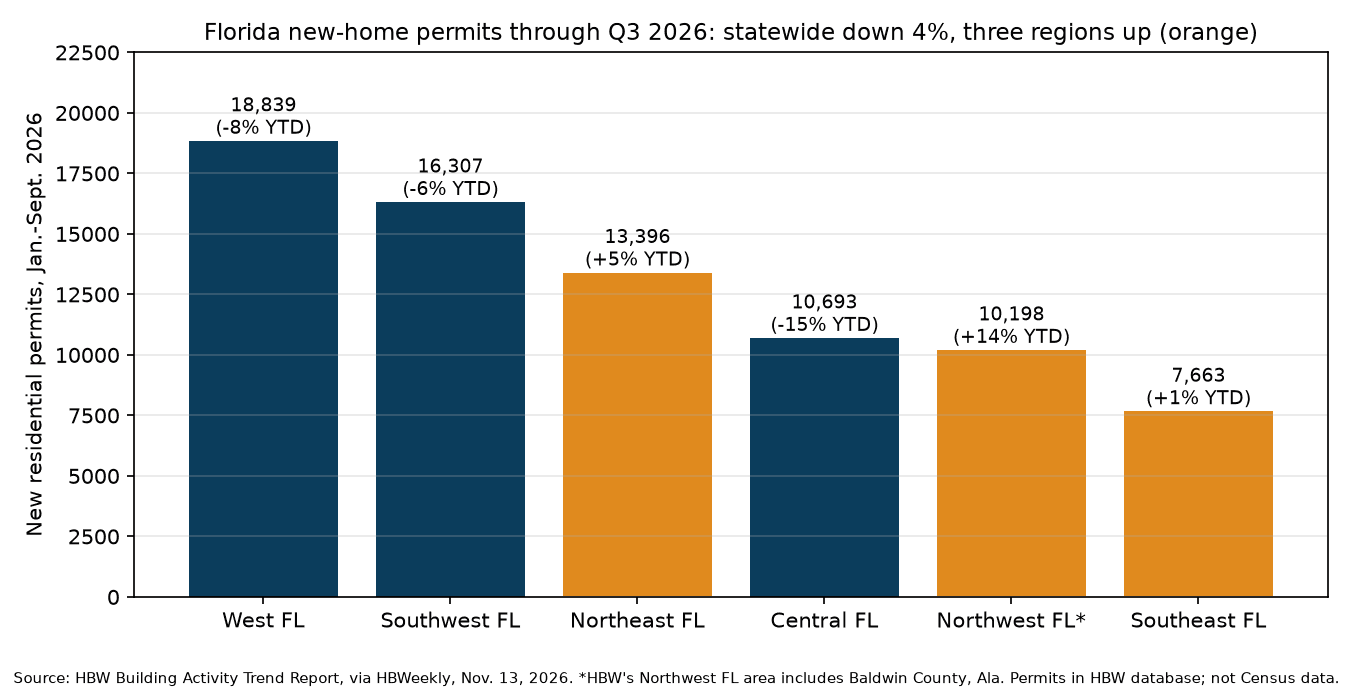
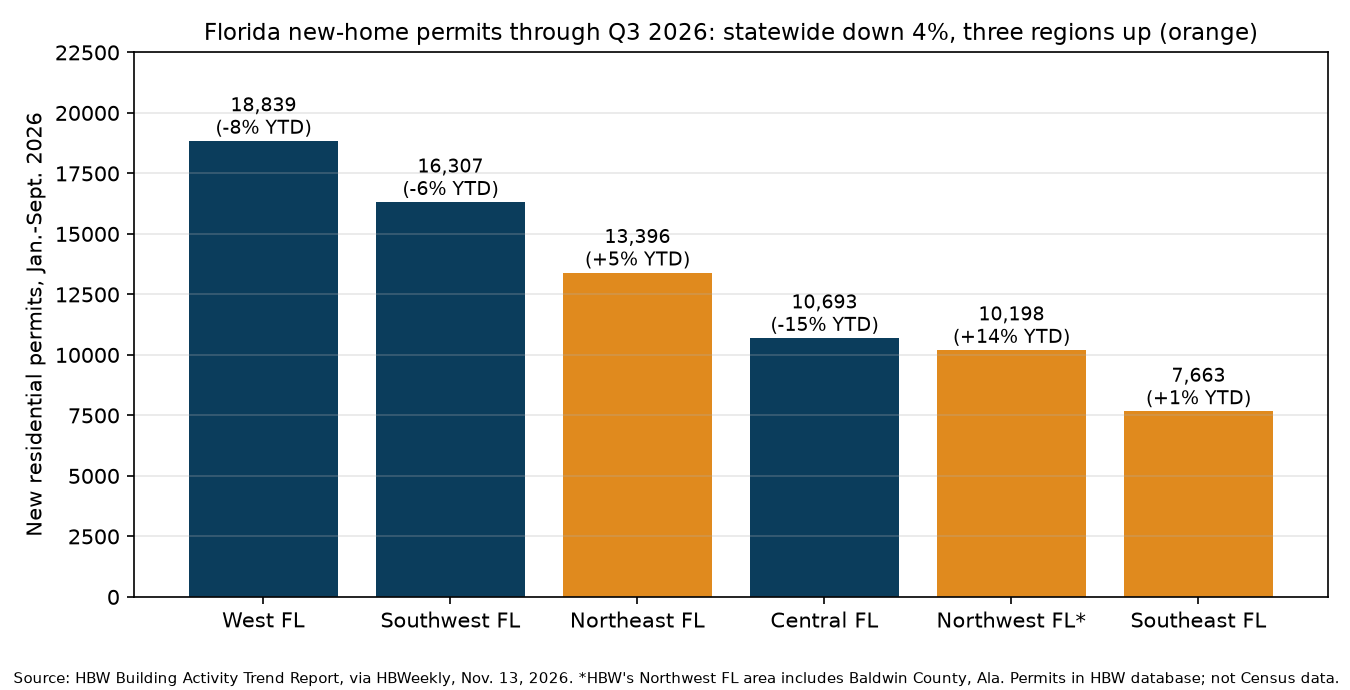
In Florida, HBW counted 77,096 new residential permits through Q3, down 4% from 2025. Northeast Florida (+5%), Northwest Florida (+14%) and Southeast Florida (+1%) bucked the trend, and permits for homes valued above $500,000 in Southeast Florida have already nearly matched all of 2025 (HBWeekly, Nov. 13, 2026).
South existing home sales fell 6.5% in October to a decade low (NAHB Eye on Housing, Nov. 12, 2026).
Builder credit is still tight. NAHB’s survey of builders and developers shows conditions on land, development and construction loans tightened for the 19th straight quarter in Q3 2026. The same survey found that 32% of builders who built single-family homes in Q3 financed some of them with a construction-to-permanent (one-time close) loan made to the home buyer, and on average 58% of those builders’ homes were financed that way (NAHB Eye on Housing, Nov. 13, 2026).
Design Note: Built for More Than One Generation
Zillow’s 2027 Home Trends Report found mentions of multigenerational living up 58% in for-sale listings, with flex spaces up 35% and home offices up 42%. Open floor plans are holding steady, but buyers want defined spaces within them (Zillow 2027 Home Trends Report, Nov. 10, 2026). The NKBA’s 2027 survey adds leak detection, automatic water shut-off valves and backup power to the list of climate-resilience features moving up homeowners’ priorities (Kitchen & Bath Design News, Nov. 5, 2026).
Lumber and Material Prices This Week
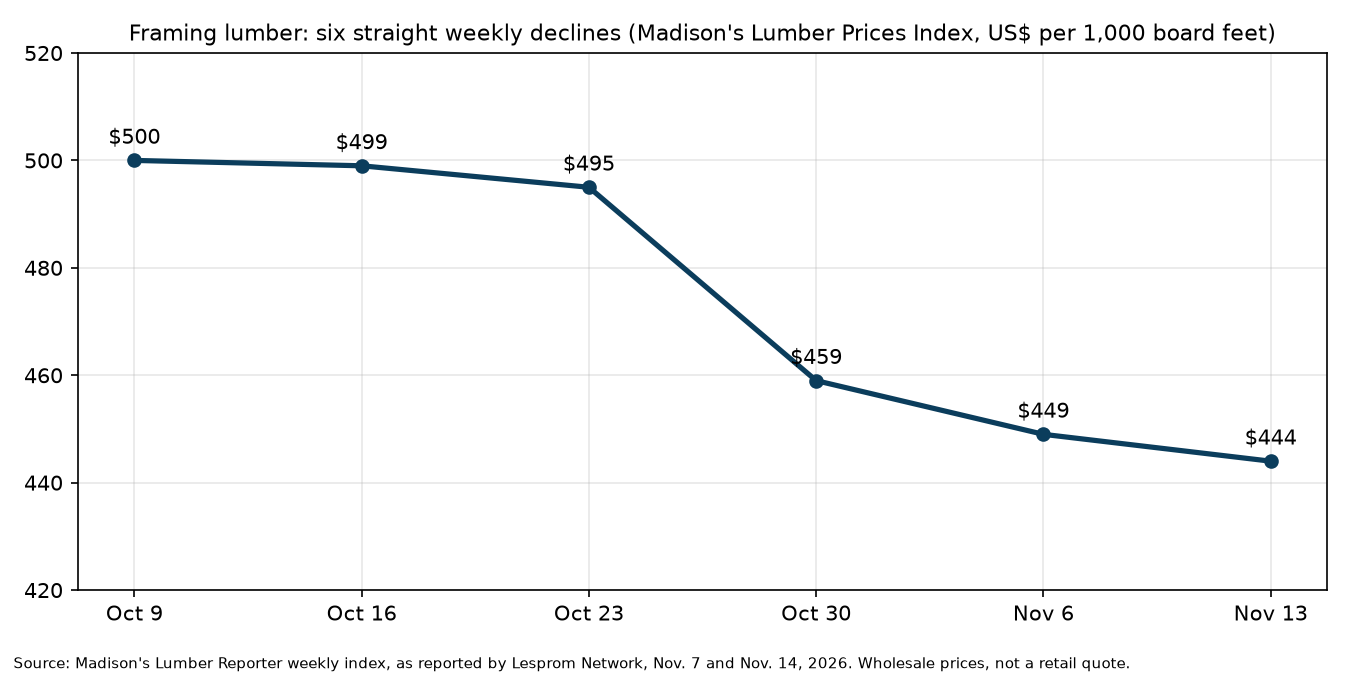
Madison’s Lumber Prices Index slipped to $444 per 1,000 board feet for the week ending Nov. 13, down $5 (1%) on the week and $51 (10%) from a month earlier. It was the sixth straight weekly decline (Lesprom Network, Nov. 14, 2026; Madison’s Lumber Reporter, Nov. 13, 2026).
The broader cost picture is less friendly. Prices for all inputs to new residential construction were up 0.3% in October and 10.4% from a year earlier. Building materials alone rose 0.5% on the month and 5.8% on the year, softwood plywood is up 24.5%, and diesel fuel, even after a 4.6% monthly drop, is up 115.2% from a year ago (NAHB Eye on Housing, Nov. 13, 2026).
Seasonal Best Practices for Southern Jobsites
NOAA’s outlook for December through February favors wetter-than-average conditions across the southern tier, from the Southwest to the Southeast and up the East Coast, with near-normal temperatures most likely in parts of the Southeast, including Florida. NOAA warned that heavy rain on dry soil can fuel flash floods (NOAA Winter Outlook, Oct. 15, 2026 (via US Harbors)). From my own jobsites:
- Get erosion and sediment control in before the first big storm, and keep it maintained. Silt fence and inlet protection fail quietly.
- Grade for drainage early so water moves away from the pad and foundation.
- Protect stored materials. Keep lumber, drywall and insulation off the ground and covered, and check moisture content before closing walls.
- Dry in fast. Roof underlayment, wrap and windows turn rainy days into working days.
- Build rain days into the schedule your client sees, so a wet month doesn’t become a surprise.
Construction Loan Rates: Where the Market Is
As of Nov. 12, 2026, Freddie Mac’s average 30-year fixed rate was 7.11%, down from 7.18% the week before, the fourth weekly decline in a row and the lowest level in seven weeks. A year ago it was 6.24% (Freddie Mac PMMS, Nov. 12, 2026). The next survey is due Thursday, Nov. 19. In my experience, construction loan rates typically run about 0.75% above conventional mortgage rates, which would put a typical construction loan somewhere around 7.9% as a general market average, depending on the program, borrower and project. For context, the 30-year averaged 7.33% in October after touching 7.40% early in the month, its highest level since 2023 (NAHB Eye on Housing, Nov. 3, 2026).
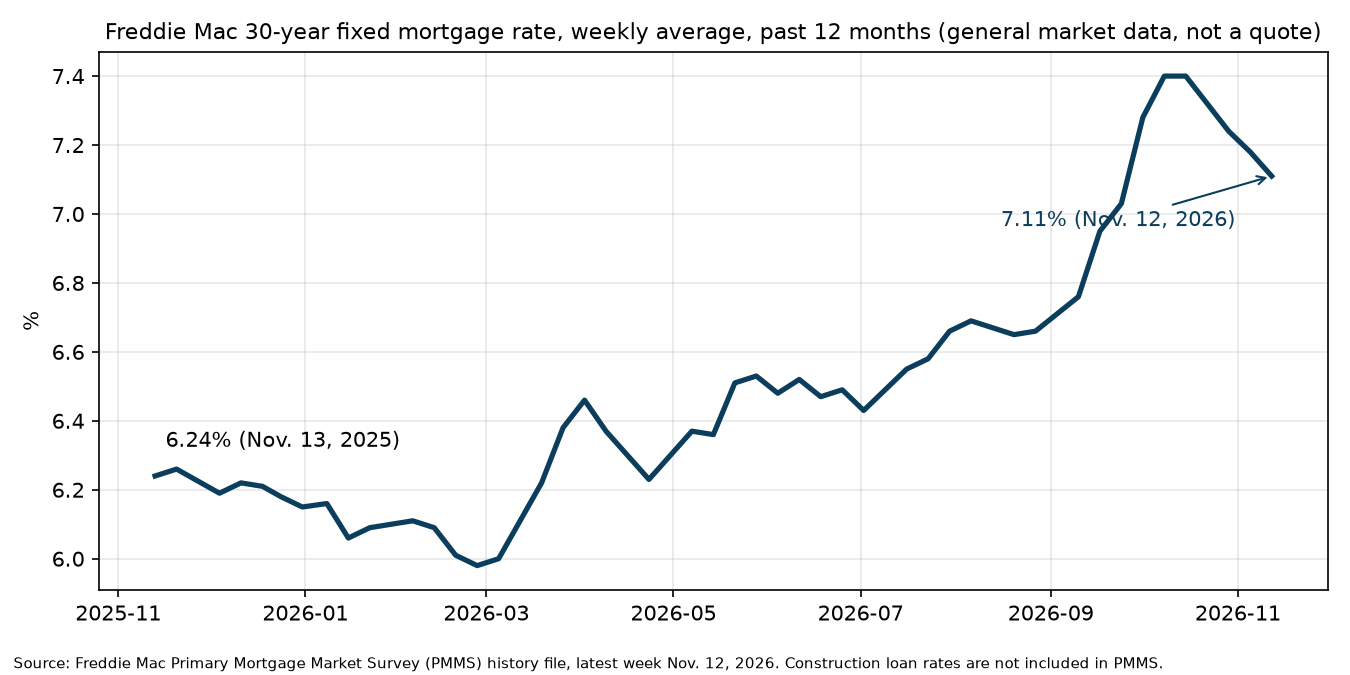
Rates shown are national market averages for general information only. They are not an offer, quote or rate lock, and construction loan rates are not part of the Freddie Mac survey; the roughly 0.75% difference is a general rule of thumb, not a pricing promise. Your actual rate and APR (annual percentage rate, which includes certain loan costs) depend on credit, loan program, property, loan amount and market conditions. Subject to credit approval; not a commitment to lend. Equal Housing Lender.
FAQ
How do construction loan rates compare with regular mortgage rates right now? As of Nov. 12, 2026, Freddie Mac’s average 30-year fixed was 7.11% (Freddie Mac PMMS, Nov. 12, 2026). Construction loans typically run about 0.75% above conventional mortgage rates, depending on the program, borrower and project. These are market averages, not a quote; your rate and APR will differ.
Is Charleston raising building permit fees? City Council approved the first reading of a new fee schedule on Nov. 10 that would take effect Jan. 1. For a $100,001 to $500,000 project, the total building permit fee would be $2,343.50, up from $1,117 in 2019 (The Post and Courier, Nov. 13, 2026).
When can I comment on the Dallas zoning draft? Public engagement starts Nov. 18 and runs through January 2027; the draft is at DallasZoningReform.com (City of Dallas, Nov. 6, 2026).
What is Austin changing for triplexes and fourplexes? Three- and four-unit buildings under 6,000 square feet would no longer need International Building Code review. Comments close Nov. 27 (Realtor.com, Nov. 2, 2026).
When is the next regional housing data? October housing starts and permits come out Nov. 18, and October new home sales on Nov. 25 (U.S. Census Bureau release schedule).
About the Author
Aaron Meilich is a licensed General Contractor and Construction Mortgage Specialist (NMLS #769327, CA Contractor License #1010953), based in Sacramento, California. He has about 30 years in construction financing and has also been building homes for the last 7 years. He originates VA, Conventional, and Jumbo one-time-close construction-to-permanent loans, and helps families and builders nationwide. Licensed in all U.S. states except Hawaii and New York. Call (916) 798-3000 or get prequalified.
Here’s what I like most for Southern custom and pre-sold builders while builder credit stays tight: with a construction-to-permanent loan, your buyer, not your company, carries the construction financing. Draws go to you as work is completed, and the loan becomes your buyer’s mortgage at the end, so you don’t have to tie up your own credit line or carry the house on your balance sheet to build it. (Builder approval, draw procedures and eligibility vary by program; subject to credit approval.)
Aaron Meilich, NMLS #769327 | CA Contractor License #1010953 | Equal Housing Lender. Subject to credit approval; not a commitment to lend. Licensing & disclosures: www.FundandBuild.com. For licensing information, visit www.nmlsconsumeraccess.org.
Featured Construction Loan Programs
Nationwide lending solutions customized to your build
Licensed in all U.S. states except Hawaii and New York.
Single closing with upfront rate lock and automated 30-year conversion.
VA, Conventional, and Jumbo one-time close construction loans.
Zero down payment, no monthly PMI custom home builds for veterans.
Ready to Structure Your Construction Loan?
Calculate your monthly construction interest, evaluate project equity, and get pre-qualified in under 3 minutes.