South Builders: Florida's Tax Vote and Factory-Built Parity, Charleston's Permit Fees, and Austin's Triplex Fix (Week of Nov. 9, 2026)
NMLS #769327 | CA Contractor License #1010953 | Licensed General Contractor
Short answer: Florida voters approved Amendment 3, which raises the homestead exemption on non-school property taxes to $150,000 in 2027 and $250,000 in 2028. A new Florida law gives qualifying factory-built homes the same zoning treatment as site-built homes starting Jan. 1. Charleston’s City Council takes up a roughly 50% increase in residential permit fees on Nov. 10, Austin wants to pull three- and four-unit buildings out of commercial code review, and Charlotte and Raleigh both passed housing bonds. Meanwhile, the 2026 hurricane season is ending as one of the quietest on record.
Election Week: Taxes and Bonds Across the South
- Florida Amendment 3 passed with 62%, above the 60% it needed. The homestead exemption on non-school property taxes rises from about $50,000 to $150,000 in 2027 and $250,000 in 2028, and the annual assessment cap for non-homestead property drops from 10% to 5%. People who aren’t Florida residents on Dec. 31, 2026, get the existing exemption when they qualify and the higher one starting in their fifth year (Inman, Nov. 4, 2026).
- North Carolina voters approved a constitutional amendment requiring the legislature to limit local property tax increases, with the limit likely set in 2027. Charlotte passed a $125 million housing bond (62%) and Raleigh a $101.5 million housing bond (nearly 65%) (Inman, Nov. 4, 2026).
- Louisiana approved Amendment 6, an added local exemption for older homeowners, and Amendment 9, which raises the income limit for the assessment freeze to $150,000 (Inman, Nov. 4, 2026).
For builders, Florida’s change matters in the sales conversation. A family weighing a new primary residence will want to understand what the higher exemption could mean for their carrying costs, and local governments may look to other fees to make up revenue. Realtor.com’s Joel Berner noted that roughly 30% of Florida local government revenue comes from property taxes (Inman, Nov. 4, 2026).
Regulation: Factory-Built Parity in Florida, Fees in Charleston, Simpler Review in Austin
Florida, Jan. 1, 2027. New Section 553.385, Florida Statutes (from HB 399, Ch. 2026-7), requires that qualifying off-site constructed homes (manufactured buildings or manufactured homes treated as real property) be permitted by right in any zoning district that allows single-family detached homes. Local governments can’t treat them more restrictively than site-built homes, though uniform setback, height and design standards that apply to both still stand. A separate statewide ADU-by-right bill (SB 48) died in March, so accessory dwelling units remain a local option (Prefabricated.co, Nov. 4, 2026).
Charleston, S.C. City Council is scheduled to consider fee changes on Nov. 10 that include an approximately 50% increase in residential building permit rates, certain engineering permit fees going from $25 to $100, and a new $200 fee for certain floodplain map revision reviews involving fill. If approved, they take effect Jan. 1, 2027. City staff say some fees haven’t been updated in more than five years and that the proposal stays in line with Charleston County and Mount Pleasant (Live 5 News, Nov. 6, 2026). If you have Charleston projects ready to go, consider submitting before year-end.
Austin, Texas. A proposed code amendment would let three- and four-unit buildings under 6,000 square feet skip International Building Code (commercial) review, while keeping fire separations, shared-exit protections and sprinklers. The city holds a virtual information session Nov. 12, takes written comments through Nov. 27, and plans to bring it to City Council in December (Realtor.com, Nov. 2, 2026).
A reminder we covered in recent weeks: applications submitted after Dec. 31 must comply with the 9th Edition Florida Building Code, so permit timing on projects designed to the current code still matters (Miami-Dade RER, Oct. 7, 2026).
Lumber and Material Prices This Week
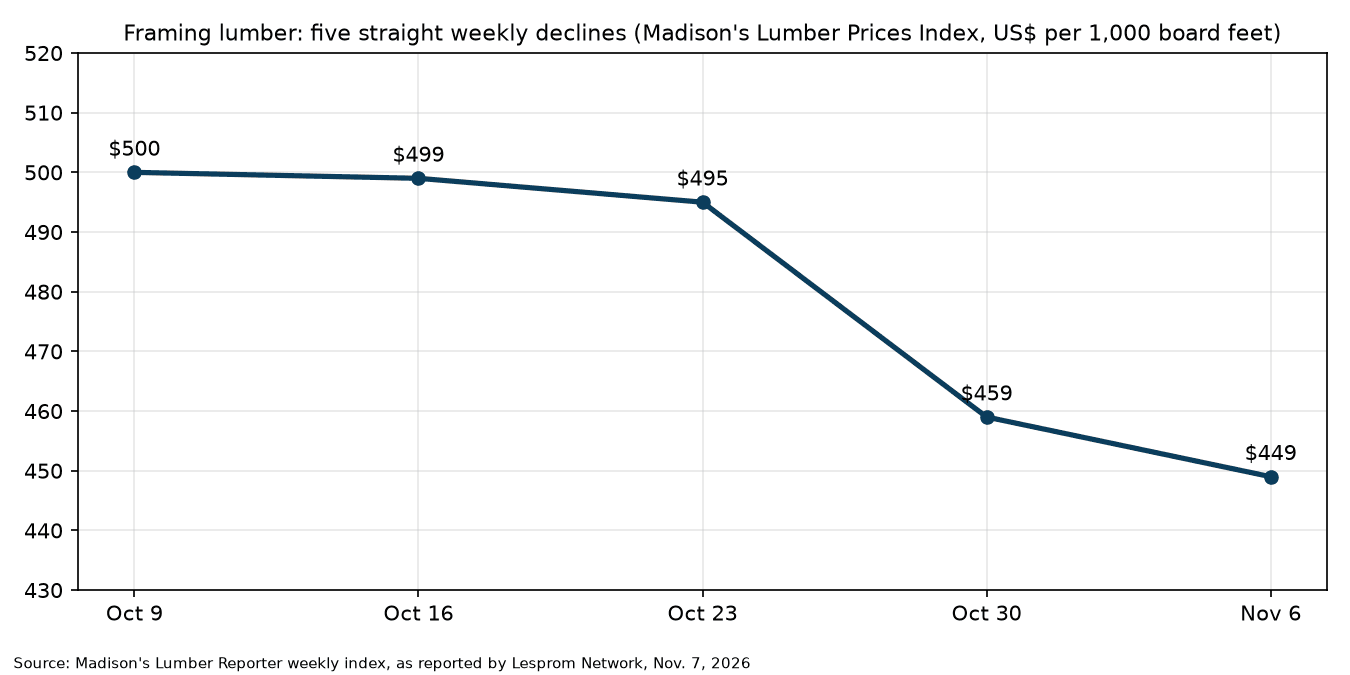
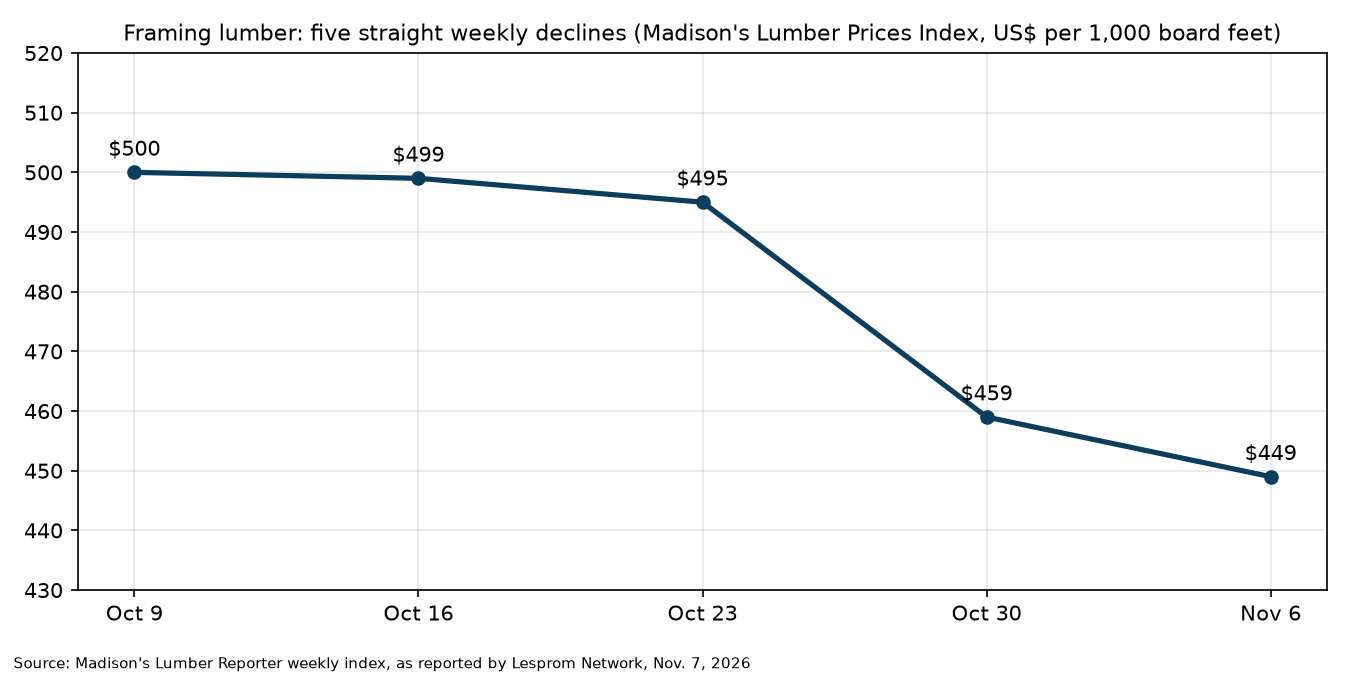
Madison’s Lumber Prices Index fell to $449 per 1,000 board feet for the week ending Nov. 6, down $10 (2%) on the week and 10% from a month earlier. It was the fifth straight weekly decline (Lesprom Network, Nov. 7, 2026). CME lumber futures closed Friday, Nov. 6 at $500, the lowest close since September 2024 and 6.3% below a year earlier (Lesprom Network, Nov. 8, 2026).
Other products are moving the other way. Announced increases include Owens Corning EXP 5% (Nov. 16), Hardie siding 4% to 7% and Azek decking 3% to 5% (Nov. 30), and ClarkDietrich steel framing 10% on Dec. 1 and another 10% on Jan. 4, 2027 (Mead Lumber Market Update, November 2026). UBS estimated in September that tariffs then in place add about $8,200 to the cost of every home, and NAHB says builders have reported tighter credit for 18 straight quarters (CRE Daily, Nov. 2, 2026).
Seasonal Best Practices for Southern Jobsites
- Take advantage of the quiet tropics, but finish the season. As of Nov. 4, the 2026 Atlantic season’s accumulated cyclone energy was 19.7, about 83% below the long-term average. Hurricane Isaias, a Category 3, was the strongest storm. Forecasters credit a strong El Niño and its wind shear (FOX10 News, Nov. 4, 2026). The season officially runs through Nov. 30, so keep tie-downs and site cleanup habits in place until then.
- Get roofs and windows in before winter rain. Drying in fast protects framing and keeps interior trades moving. Interior finishes are the longest single stage of a typical build at 6.4 weeks, so every week you protect on the front end matters (NAHB Eye on Housing, Nov. 2, 2026).
- Watch the overnight low, not the afternoon high. Even in the South, a cold front can drop temperatures under 40°F, the point where cold-weather concrete rules begin. Protect fresh pours for at least the first 24 hours (Duffy Engineering, Oct. 30, 2026).
- Order siding and trim ahead of the Nov. 30 increases where your schedule allows, and get the quote in writing.
- Book subs for spring now. Residential construction employment fell by 16,400 jobs in October, the largest monthly drop since March 2021 (NAHB Eye on Housing, Nov. 6, 2026).
Construction Loan Rates: Where the Market Is
As of Nov. 5, 2026, Freddie Mac’s average 30-year fixed rate was 7.18%, down from 7.24% the week before and the third weekly decline in a row (Freddie Mac PMMS, Nov. 5, 2026). The next survey is due Thursday, Nov. 12. In my experience, construction loan rates typically run about 0.75% above conventional mortgage rates, which would put a typical construction loan somewhere around 7.9% as a general market average, depending on the program, borrower and project. For context, the 30-year averaged 7.33% in October, up 47 basis points from September, after touching 7.40% early in the month, its highest level since 2023 (NAHB Eye on Housing, Nov. 3, 2026).
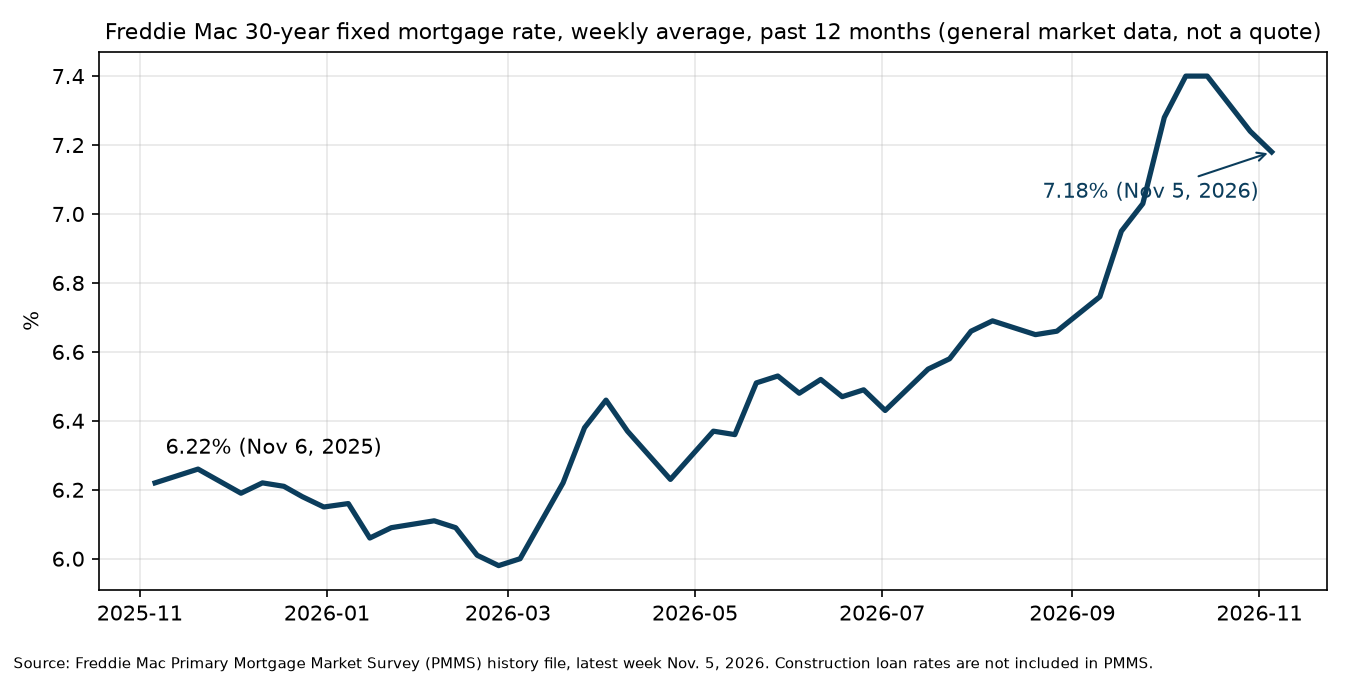
Rates shown are national market averages for general information only. They are not an offer, quote or rate lock, and construction loan rates are not part of the Freddie Mac survey; the roughly 0.75% difference is a general rule of thumb, not a pricing promise. Your actual rate and APR (annual percentage rate, which includes certain loan costs) depend on credit, loan program, property, loan amount and market conditions. Subject to credit approval; not a commitment to lend. Equal Housing Lender.
FAQ
How do construction loan rates compare with regular mortgage rates right now? As of Nov. 5, 2026, Freddie Mac’s average 30-year fixed was 7.18% (Freddie Mac PMMS, Nov. 5, 2026). Construction loans typically run about 0.75% above conventional mortgage rates, depending on the program, borrower and project. These are market averages, not a quote; your rate and APR will differ.
What does Florida Amendment 3 do? It raises the homestead exemption on non-school property taxes from about $50,000 to $150,000 in 2027 and $250,000 in 2028, with inflation adjustments after that, and lowers the non-homestead assessment cap from 10% to 5% (Inman, Nov. 4, 2026).
When does Florida’s factory-built zoning parity law take effect? Jan. 1, 2027. Qualifying off-site constructed homes treated as real property must be allowed by right wherever single-family detached homes are allowed (Prefabricated.co, Nov. 4, 2026).
How much would Charleston’s permit fees go up? Residential building permit rates would rise about 50% under the proposal, with the dollar amount depending on the project. Council is scheduled to consider it Nov. 10, with a Jan. 1, 2027 effective date if approved (Live 5 News, Nov. 6, 2026).
How can I comment on Austin’s triplex code change? Attend the virtual session on Nov. 12 at 11 a.m. or submit written comments on PublicInput through Nov. 27 (Realtor.com, Nov. 2, 2026).
When is the next regional housing data? October permits and starts come out Nov. 18 and October new home sales on Nov. 25 (U.S. Census Bureau release schedule).
About the Author
Aaron Meilich is a licensed General Contractor and Construction Mortgage Specialist (NMLS #769327, CA Contractor License #1010953), based in Sacramento, California. He has about 30 years in construction financing and has also been building homes for the last 7 years. He originates VA, Conventional, and Jumbo one-time-close construction-to-permanent loans, and helps families and builders nationwide. Licensed in all U.S. states except Hawaii and New York. Call (916) 798-3000 or get prequalified.
Here’s what I like most for Southern buyers right now, with property taxes, permit fees and material prices all in motion: with a one-time-close construction-to-permanent loan, your client is approved once, before construction starts, and the loan converts to the permanent mortgage when the home is finished. That means no second closing and no separate requalification at the end of the build, as long as the loan stays in good standing. (Program terms vary; subject to credit approval and program guidelines.)
Aaron Meilich, NMLS #769327 | CA Contractor License #1010953 | Equal Housing Lender. Subject to credit approval; not a commitment to lend. Licensing & disclosures: www.FundandBuild.com. For licensing information, visit www.nmlsconsumeraccess.org.
Featured Construction Loan Programs
Nationwide lending solutions customized to your build
Licensed in all U.S. states except Hawaii and New York.
Single closing with upfront rate lock and automated 30-year conversion.
VA, Conventional, and Jumbo one-time close construction loans.
Zero down payment, no monthly PMI custom home builds for veterans.
Ready to Structure Your Construction Loan?
Calculate your monthly construction interest, evaluate project equity, and get pre-qualified in under 3 minutes.