West Builders: California Bets on Factory-Built Homes, Washington Launches a Housing Accelerator, and Colorado's Fast-Track Deadline Nears (Week of Nov. 16, 2026)
NMLS #769327 | CA Contractor License #1010953 | Licensed General Contractor
Short answer: California signed three factory-built housing bills this year, including AB 2058, which lets state inspectors inspect factory-built housing on site, while a financial backstop bill was vetoed. Washington released the first report from its new housing accelerator (WARP), with builder input meetings starting Dec. 3. Colorado local governments have until Dec. 31 to show a 90-day fast-track review for qualifying affordable housing to stay eligible for Proposition 123 funding. Idaho ranks second nationally in permits per resident, while Nevada’s rate fell 29%. Framing lumber fell for a sixth straight week, but construction input costs are still up 10.4% from a year ago.
I’m a California-licensed general contractor, and I’ve spent 30 years in construction lending, the last 7 building homes as well. Factory-built and permit-reform news lands directly on the projects I finance, so here’s my read for Western builders this week.
California: Factory-Built Housing Gets a Push
The Assembly’s Select Committee on Housing Construction Innovation sent six bills to the governor; three were signed and three vetoed (Capitol Weekly via Times of San Diego, Nov. 15, 2026):
- AB 1815 bars local jurisdictions from enforcing building standards on factory-built housing that exceed the state’s, so factories don’t have to retool between projects.
- AB 2058 allows statewide building inspectors to inspect factory-built housing on site instead of a local inspector.
- AB 2185 requires state agencies to revise housing programs to include factory-built housing.
- AB 2166, a financial backstop to finish a project if a factory fails, was vetoed for lack of budget funding. Assemblymember Buffy Wicks says she hopes to bring the vetoed bills back next year.
Also signed: AB 2074, which streamlines residential and mixed-use projects near regional transit hubs, starting with the state’s seven largest cities. Assembly Speaker Robert Rivas also highlighted AB 1751, aimed at making townhomes faster and easier to build. Wicks’ construction defect reform bill for condos did not pass. Voters approved Proposition 1, $11.25 billion in housing bonds (Capitol Weekly, Nov. 15). The American Enterprise Institute estimates California’s AB 956 ADU law alone could add about 48,000 units a year (Realtor.com, Nov. 6, 2026).
Washington: The Housing Accelerator Wants Builder Input
Washington’s Department of Commerce delivered its first report on the Washington Accelerator for Residential Production (WARP), outlining barriers and cost drivers from planning through construction and options such as more consistent regulations across jurisdictions, infrastructure investment and support for modular and other off-site manufacturing. The state added 41,000 housing units from April 2025 to March 2026, 62% of them multifamily. Topic meetings are open to builders and lenders: regulations and permitting on Dec. 3, innovative housing types Jan. 6, financing, insurance, real estate and taxes Jan. 27, and construction costs Feb. 10. Final recommendations go to the Legislature by June 30, 2027 (Washington State Department of Commerce, Nov. 10, 2026). If you build in Washington, Dec. 3 is the meeting to attend.
Colorado: Fast-Track Deadline Dec. 31
To stay eligible for future Proposition 123 funding, Colorado local governments must show by Dec. 31, 2026 that they’ve implemented a fast-track process, effective Jan. 1, 2027, that delivers a final decision within 90 calendar days of a complete application for developments where at least half the units are affordable (Colorado Department of Local Affairs). Expect a flurry of county and city adoptions over the next six weeks.
Market Check: Idaho Up, Nevada Down
UNLV’s study of Census data for the first eight months of 2026 ranked Idaho second nationally at 6.4 permits per 1,000 residents. Nevada’s permit-to-resident ratio fell 29%, the steepest drop of any state, and Utah and Arizona also slowed (Realtor.com, Nov. 9, 2026). AEI estimates Idaho’s SB 1352, which allows homes on smaller lots, could add about 5,000 homes a year (Realtor.com, Nov. 6, 2026). West existing home sales fell 9.7% in October to a record low and were down 14.5% from a year earlier (NAHB Eye on Housing, Nov. 12, 2026).
Builder credit is still tight. NAHB’s survey of builders and developers shows conditions on land, development and construction loans tightened for the 19th straight quarter in Q3 2026. The same survey found that 32% of builders who built single-family homes in Q3 financed some of them with a construction-to-permanent (one-time close) loan made to the home buyer, and on average 58% of those builders’ homes were financed that way (NAHB Eye on Housing, Nov. 13, 2026).
Construction Tech: GAO on Off-Site Building
A new GAO technology assessment says off-site construction, automated lumber cutting and planning software can speed production and cut waste, but notes that more than 20,000 jurisdictions administer residential building codes. Its policy options include interstate code reciprocity for off-site-built homes and standardized oversize-load permitting for moving modules (U.S. GAO, GAO-27-108037, Nov. 10, 2026). That lines up closely with California’s new factory-built laws.
Lumber and Material Prices This Week
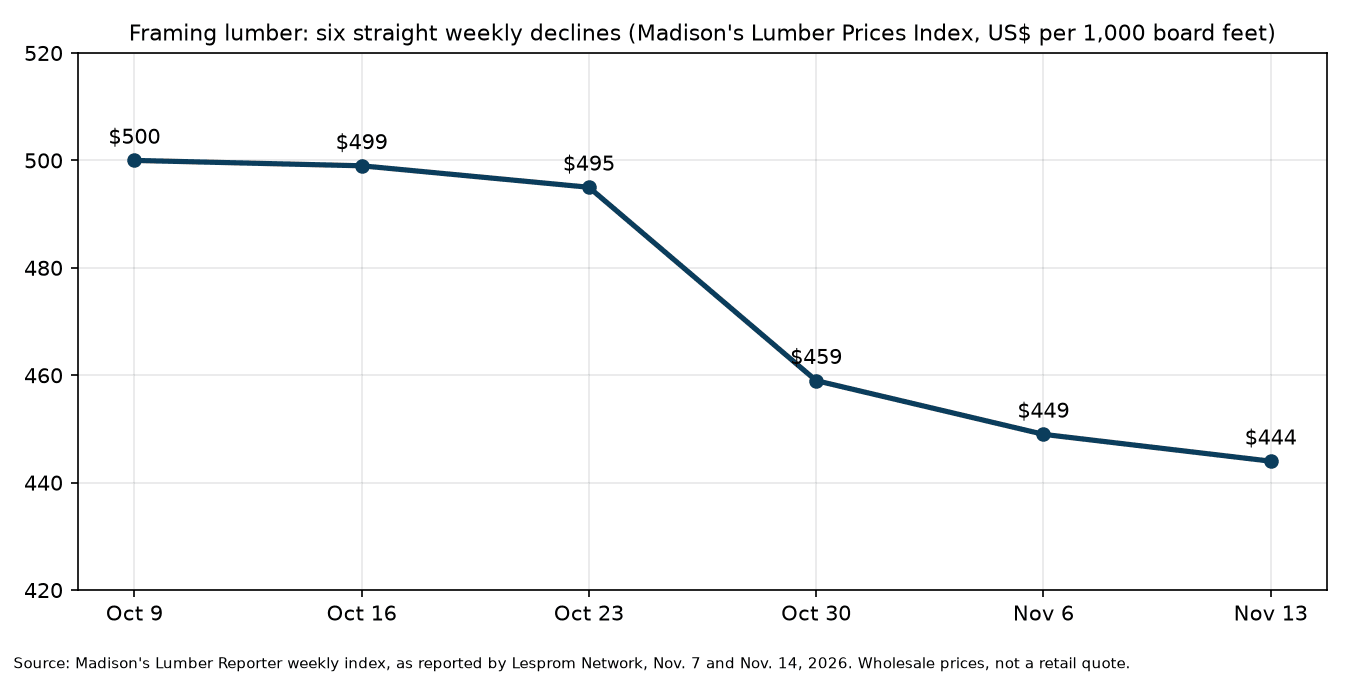
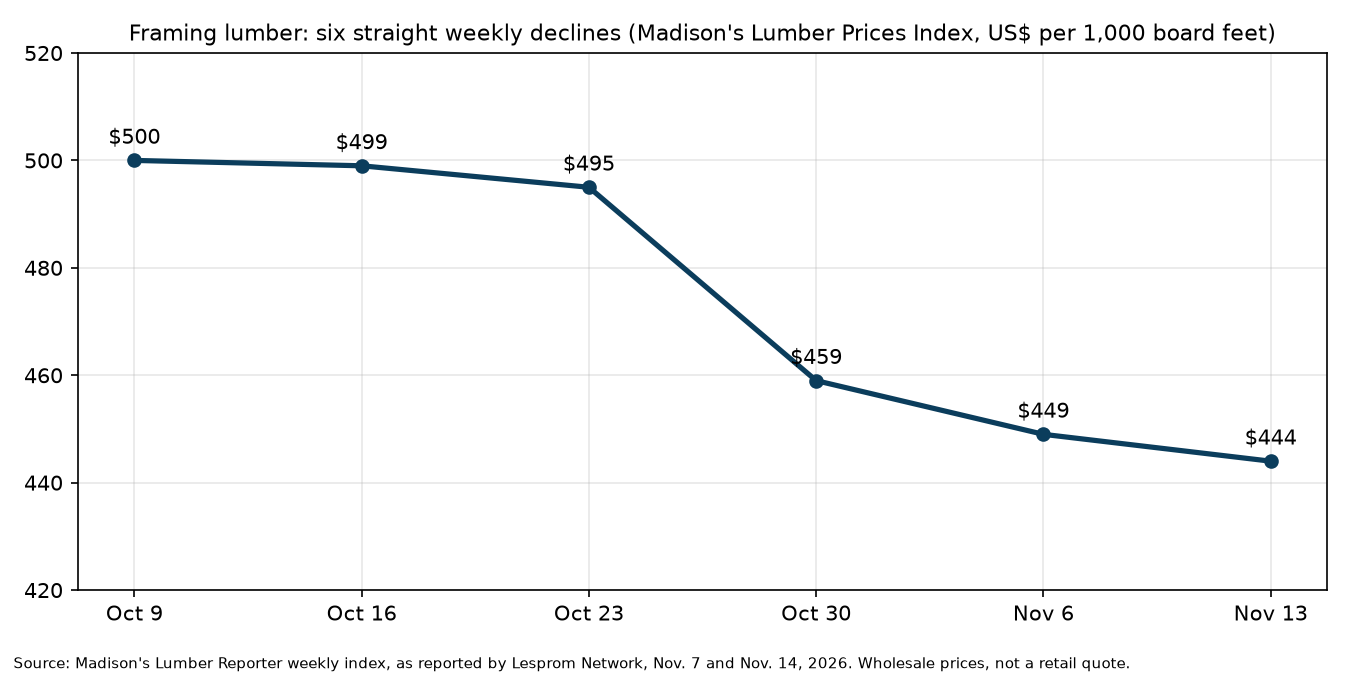
Madison’s Lumber Prices Index slipped to $444 per 1,000 board feet for the week ending Nov. 13, down $5 (1%) on the week and $51 (10%) from a month earlier. It was the sixth straight weekly decline (Lesprom Network, Nov. 14, 2026; Madison’s Lumber Reporter, Nov. 13, 2026).
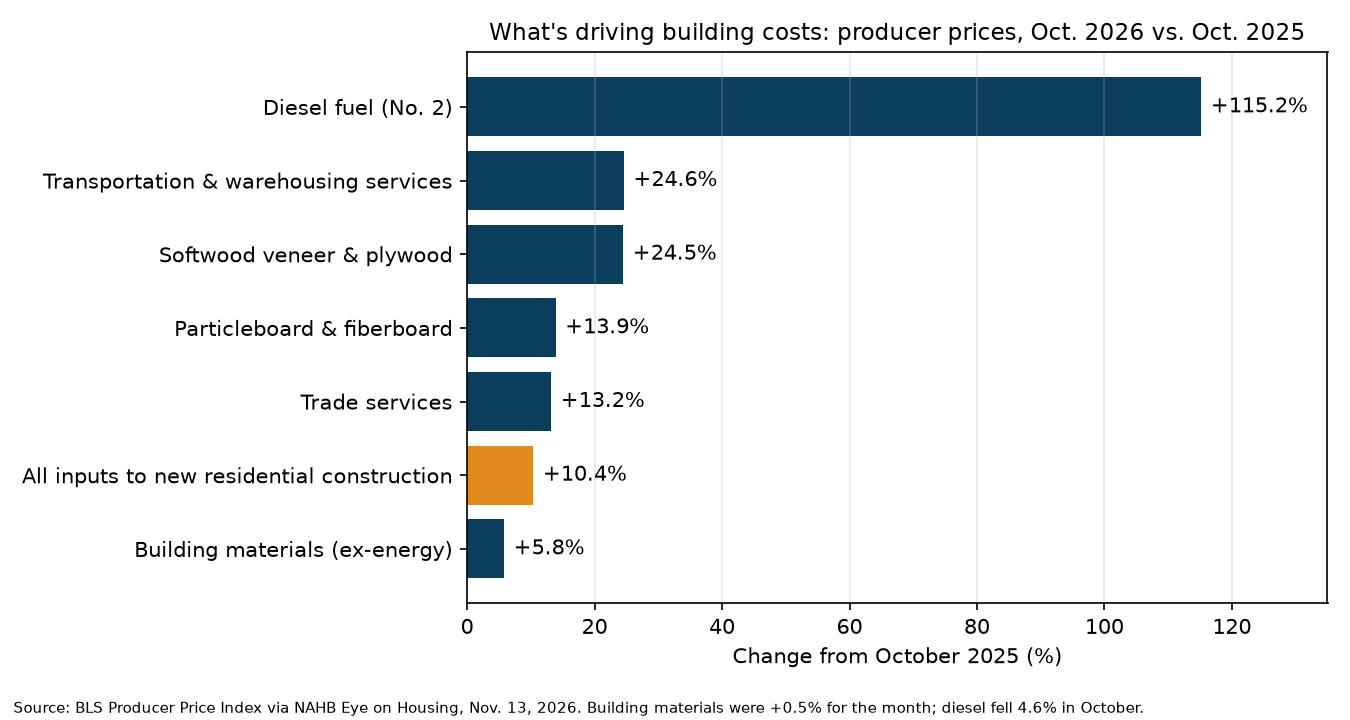
The broader cost picture is less friendly. Prices for all inputs to new residential construction were up 0.3% in October and 10.4% from a year earlier. Building materials alone rose 0.5% on the month and 5.8% on the year, softwood plywood is up 24.5%, and diesel fuel, even after a 4.6% monthly drop, is up 115.2% from a year ago (NAHB Eye on Housing, Nov. 13, 2026).
Seasonal Best Practices for Western Jobsites
NOAA’s December-through-February outlook favors wetter-than-average conditions in California and the Southwest, warmer-than-average temperatures in northern California and the Pacific Northwest, and drier-than-average conditions in parts of the northern Mountain West. NOAA specifically warned that heavy rain on dry soil can fuel flash floods and mudslides (NOAA Winter Outlook, Oct. 15, 2026 (via US Harbors)). My checklist:
- Erosion control first. Straw wattles, silt fence and stabilized construction entrances should be in before the first atmospheric river, especially on hillside and burn-area lots.
- Plan drainage around the pad and keep water off open trenches and foundations.
- Dry in quickly and protect stored lumber and sheathing from extended rain.
- In the mountains, plan for snow anyway. Drier odds don’t mean no storms. Price snow removal and temporary heat into the budget.
Construction Loan Rates: Where the Market Is
As of Nov. 12, 2026, Freddie Mac’s average 30-year fixed rate was 7.11%, down from 7.18% the week before, the fourth weekly decline in a row and the lowest level in seven weeks. A year ago it was 6.24% (Freddie Mac PMMS, Nov. 12, 2026). The next survey is due Thursday, Nov. 19. In my experience, construction loan rates typically run about 0.75% above conventional mortgage rates, which would put a typical construction loan somewhere around 7.9% as a general market average, depending on the program, borrower and project. For context, the 30-year averaged 7.33% in October after touching 7.40% early in the month, its highest level since 2023 (NAHB Eye on Housing, Nov. 3, 2026).
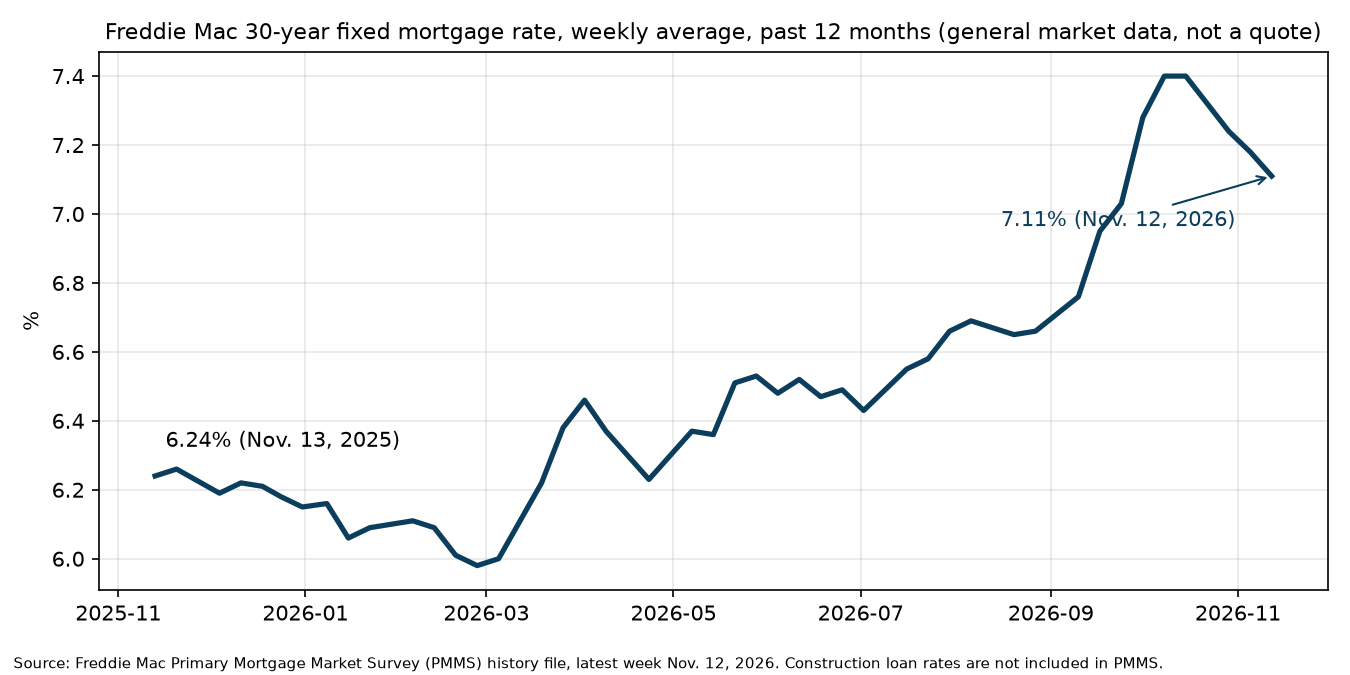
Rates shown are national market averages for general information only. They are not an offer, quote or rate lock, and construction loan rates are not part of the Freddie Mac survey; the roughly 0.75% difference is a general rule of thumb, not a pricing promise. Your actual rate and APR (annual percentage rate, which includes certain loan costs) depend on credit, loan program, property, loan amount and market conditions. Subject to credit approval; not a commitment to lend. Equal Housing Lender.
FAQ
How do construction loan rates compare with regular mortgage rates right now? As of Nov. 12, 2026, Freddie Mac’s average 30-year fixed was 7.11% (Freddie Mac PMMS, Nov. 12, 2026). Construction loans typically run about 0.75% above conventional mortgage rates, depending on the program, borrower and project. These are market averages, not a quote; your rate and APR will differ.
What is California AB 2058? It allows statewide building inspectors to inspect factory-built housing on site instead of a local inspector (Capitol Weekly via Times of San Diego, Nov. 15, 2026).
What is Washington’s WARP? The Washington Accelerator for Residential Production, a Commerce Department effort to identify barriers and cost drivers in housing production. Final recommendations are due June 30, 2027 (WA Commerce, Nov. 10, 2026).
What is Colorado’s Proposition 123 fast-track deadline? Local governments must show by Dec. 31, 2026 that they have a 90-day review process for developments with at least 50% affordable units to remain eligible for future funding (Colorado DOLA).
When is the next regional housing data? October housing starts and permits come out Nov. 18, and October new home sales on Nov. 25 (U.S. Census Bureau release schedule).
About the Author
Aaron Meilich is a licensed General Contractor and Construction Mortgage Specialist (NMLS #769327, CA Contractor License #1010953), based in Sacramento, California. He has about 30 years in construction financing and has also been building homes for the last 7 years. He originates VA, Conventional, and Jumbo one-time-close construction-to-permanent loans, and helps families and builders nationwide. Licensed in all U.S. states except Hawaii and New York. Call (916) 798-3000 or get prequalified.
Here’s what I like most for Western clients who already own their land: on many construction-to-permanent programs, the equity in a lot you own can count toward your down payment on the build, so families who bought land years ago, or who are rebuilding on a lot they already own, may need less cash out of pocket to get started. (Land value is determined by appraisal, and eligibility and requirements vary by program; subject to credit approval.)
Aaron Meilich, NMLS #769327 | CA Contractor License #1010953 | Equal Housing Lender. Subject to credit approval; not a commitment to lend. Licensing & disclosures: www.FundandBuild.com. For licensing information, visit www.nmlsconsumeraccess.org.
Featured Construction Loan Programs
Nationwide lending solutions customized to your build
Licensed in all U.S. states except Hawaii and New York.
Single closing with upfront rate lock and automated 30-year conversion.
VA, Conventional, and Jumbo one-time close construction loans.
Zero down payment, no monthly PMI custom home builds for veterans.
Ready to Structure Your Construction Loan?
Calculate your monthly construction interest, evaluate project equity, and get pre-qualified in under 3 minutes.