West Builders: California's $25 Billion New-Home Loan Program, Prop 45 Falls, and Denver Puts AI on Permit Intake (Week of Nov. 9, 2026)
NMLS #769327 | CA Contractor License #1010953 | Licensed General Contractor
Short answer: California voters approved Proposition 37, which lets the state’s housing finance agency issue up to $25 billion in bonds for second mortgages covering up to 17% of the price of a qualifying newly built home, and Proposition 1, an $11.25 billion housing bond. They rejected Proposition 45’s environmental review changes. Hawaii approved infrastructure bonds for housing. In Colorado, Denver launched an AI tool that checks permit applications for completeness, and Arapahoe County is drafting a 90-day fast track ahead of a Dec. 31 state deadline.
Election Week: California Builds a New-Home Buyer Program
Proposition 37 passed with about 61% (Inman, Nov. 4, 2026). Here’s how the Legislative Analyst’s Office describes it (LAO, Prop. 37 analysis, Nov. 3, 2026 ballot):
- The California Housing Finance Agency (CalHFA) may sell up to $25 billion in revenue bonds to fund a “middle-class homeownership loan.”
- Each loan can cover up to 17% of the home price. The buyer must put down at least 3%.
- Buyers must be California residents with household income no more than double the typical income in their area, and must be the home’s first purchaser, with price limits on eligible homes.
- Any developer can build eligible homes. Builders that opt into a “qualified builder option” accept higher labor standards in exchange for different construction defect rules.
- CalHFA decides how much to issue and when, so program details and timing are still to come.
Since the program is aimed at newly built homes, I expect it to come up in conversations with California builders and buyers in 2027. Until CalHFA publishes guidelines, I wouldn’t promise anyone eligibility, but it’s worth watching closely.
Proposition 1 passed with roughly 60%: $11.25 billion in housing bonds, including $1.25 billion for veterans’ housing and $175 million for University of California student housing (Smart Cities Dive, Nov. 6, 2026).
Proposition 45 failed. It would have capped environmental reviews for “essential” projects, including housing, at 365 days and required courts to rule on CEQA lawsuits within 270 days. Roughly 55% voted no when the race was called Saturday night. Supporters, including the California Building Industry Association, say they’ll keep pushing for reform (KQED, Nov. 8, 2026). For builders, that means CEQA timelines on larger projects stay as they are for now.
Hawaii’s RISE bond amendment passed. Counties can issue Resilient Infrastructure for Shelter and Equity bonds for public improvements in designated districts, repaid from property tax growth and kept outside county debt limits (Inman, Nov. 4, 2026; Smart Cities Dive, Nov. 6, 2026).
Permitting and Construction Tech: Denver and Arapahoe County
Denver’s StartSmart: Application Intake Assistant launched Nov. 5. The AI-powered tool, built with vendor CivCheck, gives an instant completeness check on formal site development plans and building permit applications and connects to the city’s E-permits portal. More application types are expected in 2027. City staff still make the final call on whether an application is ready for plan review and whether permits are approved (City and County of Denver, Nov. 5, 2026). An incomplete application can cost days of back-and-forth, so run every submittal through the tool.
Arapahoe County’s proposed fast track would aim for a final decision within 90 calendar days after a qualifying affordable-housing application (at least half the units affordable) is complete. It would start with a presubmittal meeting within five business days and a 10-business-day first review. Colorado requires local governments to show by Dec. 31, 2026, that they’ve adopted a fast-track process to stay eligible for Proposition 123 funding; commissioners see the outline Nov. 10 (The Badger, Nov. 7, 2026).
Portland’s cottage clusters keep spreading. The city gives them more allowable square footage and exempts them from design review if they meet standards such as a 900-square-foot maximum building footprint and at least 750 square feet of common yard. They’re now the most popular option on single lots, ahead of conventional single-family houses. A Northwest Portland lot listed at $300,000 sold for $540,000 as a cluster site, with four homes targeted at $700,000 to $800,000 each, though one broker cautioned that some cluster inventory is selling slowly (NW Examiner, Nov. 8, 2026).
Design Note: Multigenerational Homes Stay on Top
In the AIA’s latest Home Design Trends Survey, accommodations for multiple generations (net 53% of architects reporting rising popularity) and first-floor primary suites (52%) led special home features. Interest in in-law suites and junior ADUs moderated to 34% from 46% a year earlier but remains high (AIA Home Design Trends Survey, Q3 2026 report).
Lumber and Material Prices This Week
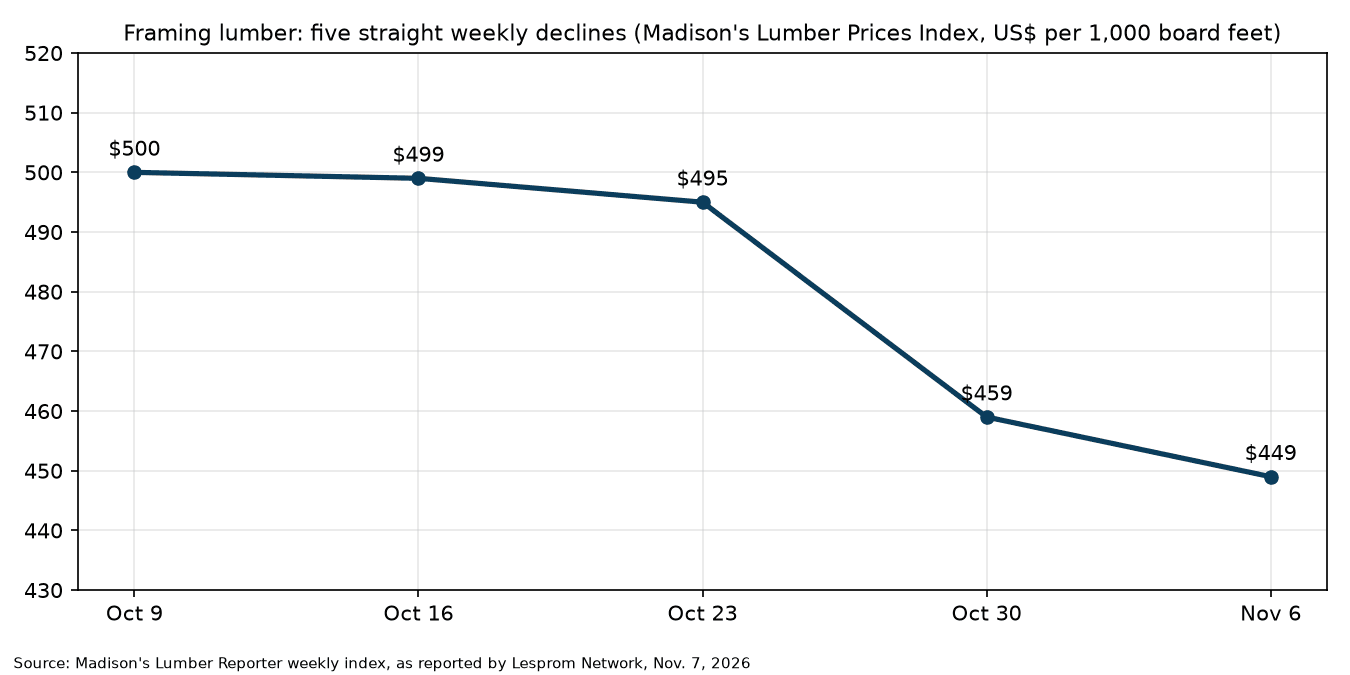
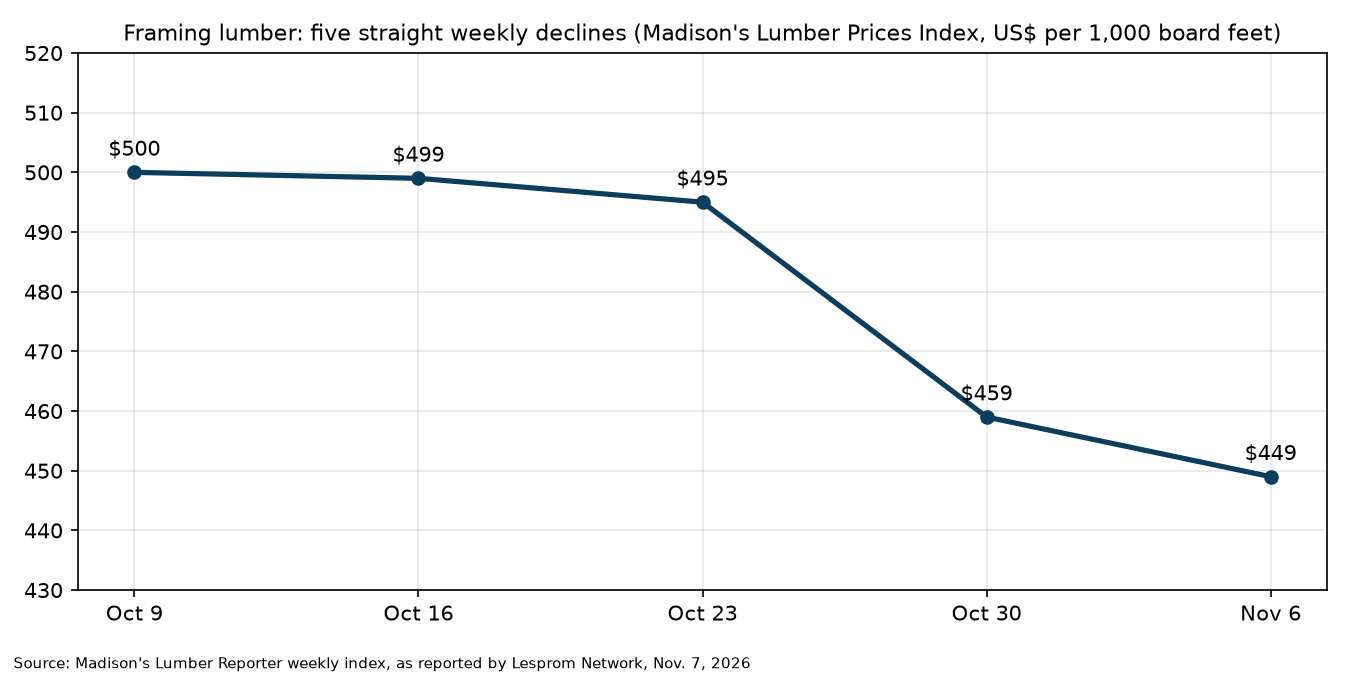
Madison’s Lumber Prices Index fell to $449 per 1,000 board feet for the week ending Nov. 6, down $10 (2%) on the week and 10% from a month earlier. It was the fifth straight weekly decline (Lesprom Network, Nov. 7, 2026). CME lumber futures closed Friday, Nov. 6 at $500, the lowest close since September 2024 and 6.3% below a year earlier (Lesprom Network, Nov. 8, 2026).
Not everything is getting cheaper. Announced increases include Hardie siding 4% to 7% and Azek decking 3% to 5% (Nov. 30) and ClarkDietrich steel framing 10% on Dec. 1 and Jan. 4, 2027 (Mead Lumber Market Update, November 2026).
Seasonal Best Practices for Western Jobsites
A Utah custom builder with 400-plus homes behind it shared how winter actually plays out (Ensign Custom Homes, Oct. 26, 2026):
- Know where the house will be by mid-November. Get the hole dug and footings in before the hard freeze when you can, and never leave frost under footings.
- Plan on 10% to 20% more framing time in winter for snow removal, icy sheathing and short days.
- Dry in fast. Roof sheathing, underlayment, house wrap and windows turn an outdoor job into an indoor one. In the mountains, an ice-and-water membrane can protect the structure until finish roofing in spring.
- Manage moisture. Fresh concrete, drywall mud and propane heaters all add water vapor. Ventilate, dehumidify and let lumber reach proper moisture content before closing walls.
- Price winter adders up front. Temporary heat, ground thaw, snow removal and enclosures belong in the budget, not the contingency.
Residential construction employment fell by 16,400 jobs in October, the largest monthly drop since March 2021 (NAHB Eye on Housing, Nov. 6, 2026), so winter may be a good window to secure subs.
Construction Loan Rates: Where the Market Is
As of Nov. 5, 2026, Freddie Mac’s average 30-year fixed rate was 7.18%, down from 7.24% the week before and the third weekly decline in a row (Freddie Mac PMMS, Nov. 5, 2026). The next survey is due Thursday, Nov. 12. In my experience, construction loan rates typically run about 0.75% above conventional mortgage rates, which would put a typical construction loan somewhere around 7.9% as a general market average, depending on the program, borrower and project. For context, the 30-year averaged 7.33% in October, up 47 basis points from September, after touching 7.40% early in the month, its highest level since 2023 (NAHB Eye on Housing, Nov. 3, 2026).
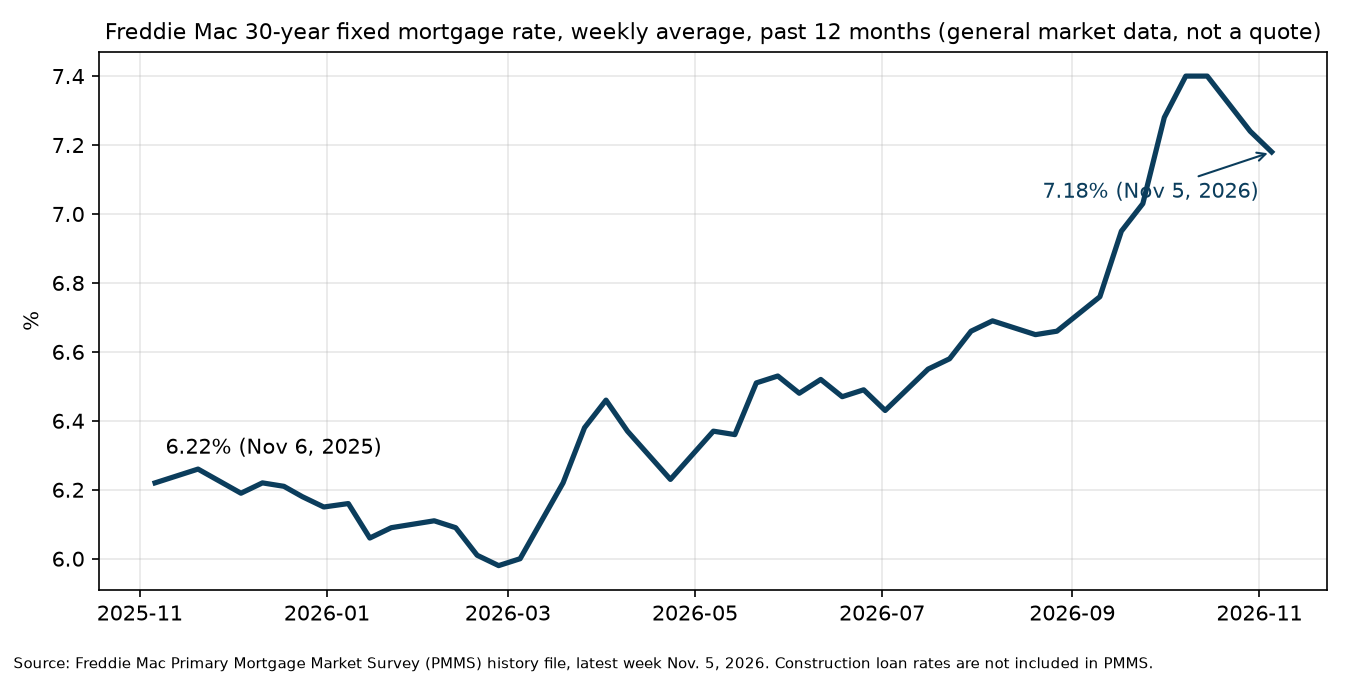
Rates shown are national market averages for general information only. They are not an offer, quote or rate lock, and construction loan rates are not part of the Freddie Mac survey; the roughly 0.75% difference is a general rule of thumb, not a pricing promise. Your actual rate and APR (annual percentage rate, which includes certain loan costs) depend on credit, loan program, property, loan amount and market conditions. Subject to credit approval; not a commitment to lend. Equal Housing Lender.
FAQ
How do construction loan rates compare with regular mortgage rates right now? As of Nov. 5, 2026, Freddie Mac’s average 30-year fixed was 7.18% (Freddie Mac PMMS, Nov. 5, 2026). Construction loans typically run about 0.75% above conventional mortgage rates, depending on the program, borrower and project. These are market averages, not a quote; your rate and APR will differ.
What is California Proposition 37? A voter-approved measure that lets CalHFA issue up to $25 billion in revenue bonds for second-mortgage loans covering up to 17% of the price of a qualifying new home. Buyers put down at least 3% and must meet income, residency and first-purchaser rules (LAO, Prop. 37 analysis).
Did Proposition 45 pass? No. California voters rejected it; roughly 55% voted no when it was called on Nov. 7 (KQED, Nov. 8, 2026).
What does Denver’s StartSmart tool do? It checks permit applications for completeness and correctness before they enter the review queue. It doesn’t approve permits; city staff still make those decisions (City and County of Denver, Nov. 5, 2026).
How much longer does winter framing take? One Utah builder plans for roughly 10% to 20% more time than a June frame (Ensign Custom Homes, Oct. 26, 2026).
When is the next regional housing data? October permits and starts come out Nov. 18 and October new home sales on Nov. 25 (U.S. Census Bureau release schedule).
About the Author
Aaron Meilich is a licensed General Contractor and Construction Mortgage Specialist (NMLS #769327, CA Contractor License #1010953), based in Sacramento, California. He has about 30 years in construction financing and has also been building homes for the last 7 years. He originates VA, Conventional, and Jumbo one-time-close construction-to-permanent loans, and helps families and builders nationwide. Licensed in all U.S. states except Hawaii and New York. Call (916) 798-3000 or get prequalified.
Here’s what I like most for Western families building for more than one generation: a construction-to-permanent loan can often include an attached in-law suite or, where local zoning and the program allow, an accessory dwelling unit as part of the same project, so it’s planned, financed and inspected along with the main house instead of bolted on later with separate financing. (Property eligibility, zoning and appraisal requirements vary by program; subject to credit approval.)
Aaron Meilich, NMLS #769327 | CA Contractor License #1010953 | Equal Housing Lender. Subject to credit approval; not a commitment to lend. Licensing & disclosures: www.FundandBuild.com. For licensing information, visit www.nmlsconsumeraccess.org.
Featured Construction Loan Programs
Nationwide lending solutions customized to your build
Licensed in all U.S. states except Hawaii and New York.
Single closing with upfront rate lock and automated 30-year conversion.
VA, Conventional, and Jumbo one-time close construction loans.
Zero down payment, no monthly PMI custom home builds for veterans.
Ready to Structure Your Construction Loan?
Calculate your monthly construction interest, evaluate project equity, and get pre-qualified in under 3 minutes.